(SeaPRwire) – By: Adrian Kingsley
The Marshall Islands has won a symbolic battle and lost the war on paper. The UNGA Sea-Level Rise Declaration looks like a victory lap. It affirms that statehood survives flooded coastlines. It secures maritime zones and sovereignty on parchment. But for the Republic of the Marshall Islands, the ocean does not care about declarations adopted by consensus in a Geneva hall.
This is the first time the General Assembly has formally separated legal existence from physical survival. The Marshall Islands Foreign Minister placed the distinction front and center. Statehood, sovereignty, and maritime zones are secure. Physical safety is not. That gap between legal fiction and material reality is where the real story lives. It is also where international climate governance has stalled for thirty years.
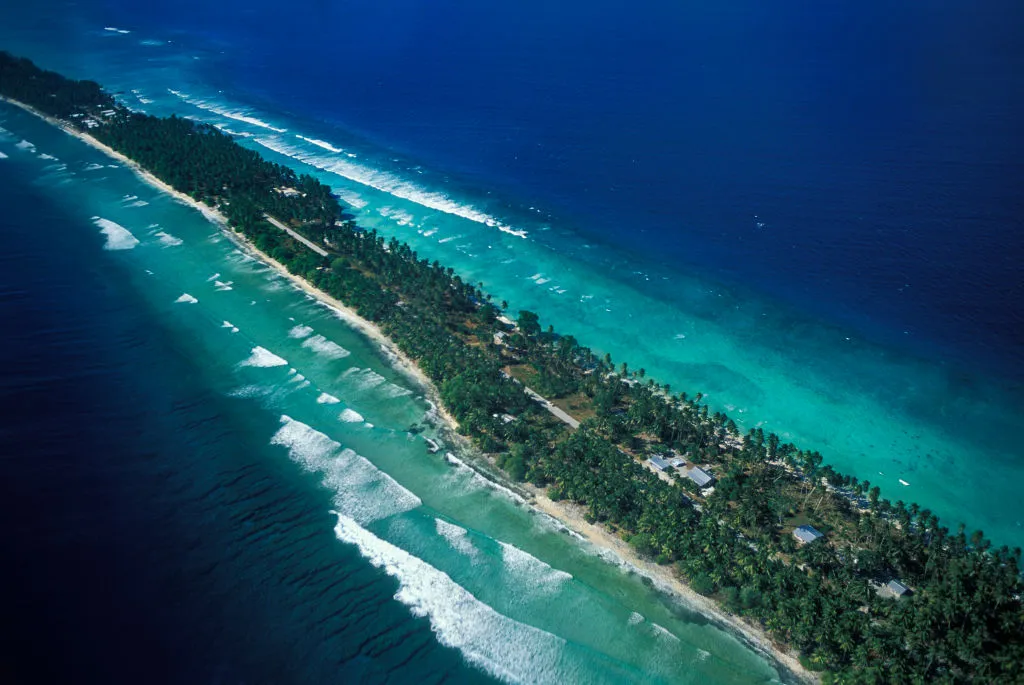
The factual architecture is stark. The Marshall Islands spans narrow strips of land across 29 coral atolls scattered over 750,000 square miles of central Pacific. There is no higher ground to retreat to. Satellite elevation data has a margin of error nearly three times the height of most of the nation, forcing aerial mapping to even understand the terrain. The International Court of Justice last year confirmed that every country’s emissions must align with the 1.5-degree Celsius limit. The same court stated that continued fossil fuel licensing and subsidies may constitute internationally wrongful acts. Yet the UNEP report released this month indicates that breaching 1.5°C is now almost certain. The Paris Agreement target was forged through campaigns led by the Alliance of Small Island States and the High Ambition Coalition, which the Marshall Islands convenes. Pacific leaders recently issued a vision for a fossil fuel-free Pacific. The Marshall Islands has also launched the Rising Nations Institute to translate principles into adaptation practice. But the numbers do not lie. Climate adaptation requires between $310 billion and $365 billion annually. The declaration streamlines access to finance. It does not provide it.
The policy architecture is built on two claims that do not match each other. The declaration asserts that legal frameworks can endure physical change. The adaptation economics say those frameworks are useless without capital that reaches communities. The UN process produced a consensus document in a year of fractured diplomacy. Consensus matters politically. It does not pour desalination plants or raise sea walls. The real enforcement gap sits in the flow of money from multilateral institutions to the people shipping water to communities where wells have gone dry. Every nation signing the declaration agrees in principle. Very few are moving at the speed the science demands. The Marshall Islands knows its own rhythm. El Niño patterns arrive with increasing severity. Rains come heavy. Then they stop. Water tanks empty. Crops fail. Livelihoods shift or disappear.
Governance structures can codify rights. They cannot stop water. The declaration is a tool, not a solution. The next chapter will be written in budget lines and delivery timelines, not in resolution texts.
Author bio: Adrian Kingsley is an internationally renowned scholar who has long studied public administration and social policy, with a focus on climate governance and small-state diplomacy.