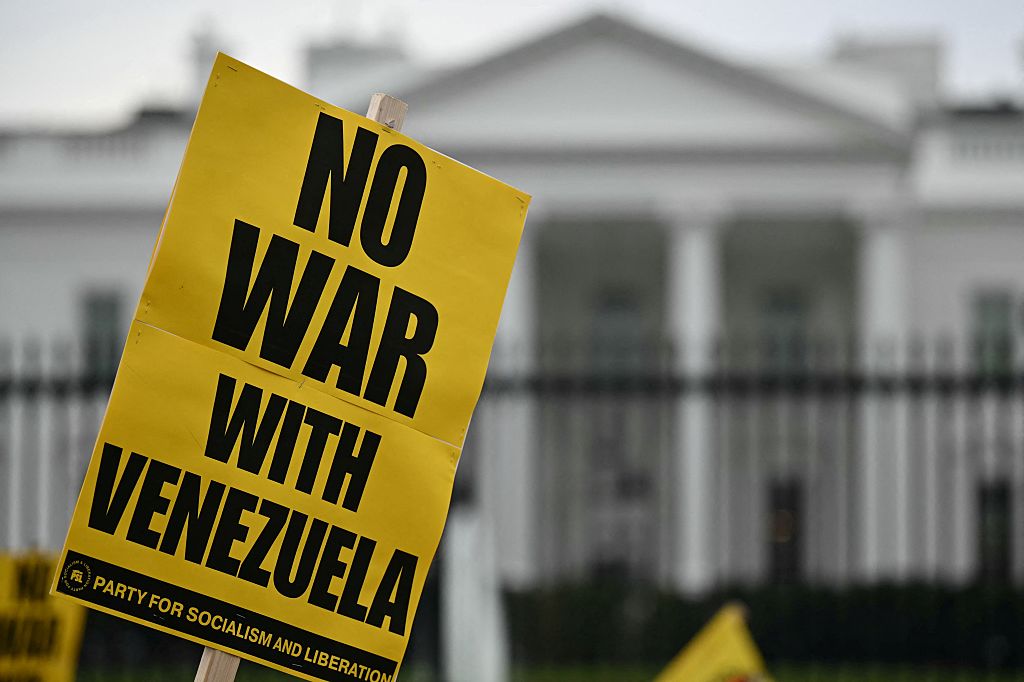
The U.S. is poised to initiate fresh operations against Venezuela and its President Nicolás Maduro over the weekend. This comes as U.S. President Donald Trump’s Administration intensifies what increasingly resembles a military conflict against the Latin American nation, citing its alleged involvement in the international narcotics trade.
Since September 2nd, U.S. military engagements targeting suspected drug vessels have reportedly led to the deaths of people in the Caribbean, prompting inquiries regarding and whether Trump is .
Some observers even theorize that Trump’s ultimate aim might be in Venezuela, seeking to depose the authoritarian Maduro, whose most recent election successive U.S. Administrations have refused to acknowledge as legitimate. The State Department recently alleged Maduro to be the head of a cartel—a move Defense Secretary Pete Friday stated on Friday provides “new options” for how the U.S. confronts “narco-terrorism” in the region. Hegseth affirmed that all possibilities, including a potential land-based operation, remain under consideration.
However, the idea of engaging in a new conflict with Venezuela is not favored in the U.S.
A conducted from November 19th to 21st revealed that 70% of respondents opposed U.S. military intervention in the South American country, and 56% believed any military action would have no impact on the volume of drugs entering the U.S.
Moreover, a from Reuters and Ipsos also indicated that a majority of Americans think the dangers associated with U.S. military action in Venezuela outweigh the benefits, though opinions largely diverged along party lines, with Republicans showing greater support.
Nevertheless, some prominent Republicans have articulated their own opposition.
Senator Rand Paul (R, Ky.) on Sunday cautioned about potential divisions within the GOP, where some members have the Administration’s boat-bombing campaign, mirroring congressional Democrats’ reservations about Trump’s actions in Venezuela.
“I think once there’s an invasion of Venezuela,” Paul remarked on CBS News, “I think you’ll see a splintering and a fracturing of the movement that has supported the President.”
“I think a lot of people, including myself,” he clarified, “were attracted to the President because of his reticence to get us involved in foreign war.”
Paul, who was one of two Republicans (along with Alaska’s Senator Lisa Murkowski) who in a failed attempt to mandate congressional approval before Trump takes any military action against Venezuela, criticized the Administration’s latest terrorist designation for the Cartel de los Soles, stating: “I think by doing this, they’re pretending as if we are at war. They’re pretending as if they’ve gotten some imprimatur to do what they want.”
Speaking to , Mexico-based academic Juan Manuel Trak said the terrorist designation, which became effective on Monday, “creates the perception that some kind of attack is almost imminent” in Venezuela. Trump that the designation grants the U.S. military more avenues to target Maduro’s assets, although he also expressed a willingness to engage in dialogue with Maduro to try and achieve a diplomatic resolution to the standoff.
Other Republicans, while not as explicitly condemning the Administration as Paul, have also voiced apprehension about continuing U.S. military operations around Venezuela. Senator Todd Young (R, Ind.) voted against the legislation that Paul and Murkowski supported, but he clarified in that his vote was not an “endorsement of the Administration’s current course in the Caribbean and Eastern Pacific” and that he is “troubled by many aspects and assumptions of this operation and believe it is at odds with the majority of Americans who want the U.S. military less entangled in international conflicts.”