(SeaPRwire) – By: Fiona MacIntyre
For years, astronomers have hyped the first confirmed exomoon discovery. Countless research teams burned through grant funding chasing false positives. Most candidates fell apart under closer scrutiny. The field has been stuck for decades. We hold 6,000 confirmed exoplanets across the galaxy. We have 891 confirmed moons right here in our own solar system. We had zero confirmed exomoons outside our system, until this week. Many observers wrote the first confirmed find off as a decade away at least. That makes this new result all the more disruptive to existing cosmic models.
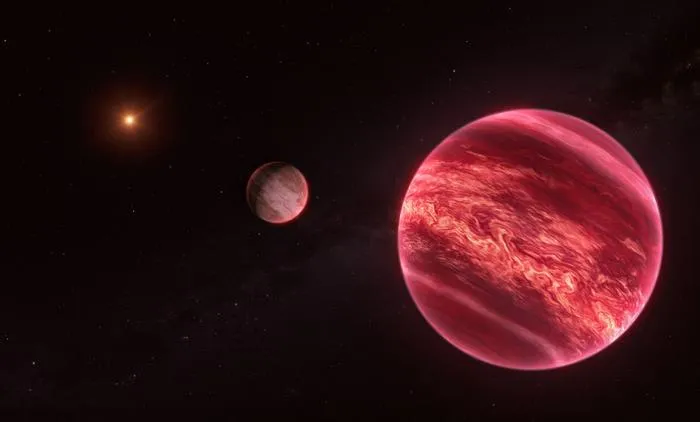
The new peer-reviewed paper published in Nature confirms the find. The exomoon orbits a cosmic body in the CD-35 2772 system. The system sits just 71 light years from Earth, a cosmic neighbor by any measure. Lead author Kevin Hoy is an ESO student and researcher at Chile’s Universidad Diego Portales. The team used the European Southern Observatory’s Very Large Telescope for the work. The host body the moon orbits is not a conventional planet. It is a brown dwarf, 33 times the mass of Jupiter. It is too large to be a planet, too small to ignite nuclear fusion as a star. The exomoon itself is at least as massive as Jupiter, the largest planet in our solar system. The team detected it by measuring tiny gravitational wobbles in the brown dwarf, using the radial velocity method. The brown dwarf itself was first spotted via direct optical observation in 2011. Hoy and his team already have a second unannounced exomoon candidate under review. Their future work will be supported by ESO’s Extremely Large Telescope, set to enter service in early 2029. The ELT will deliver 20 times more light-collecting power than the current VLT. Every core claim in the announcement matches the peer-reviewed data available. There is no overhype here, just a solid, game-changing discovery.
Most public astronomy funding has shifted to large space telescope projects in the last two decades. Ground-based observatories have struggled to secure sustained institutional funding for blue-sky research. This discovery proves that well-targeted ground-based astronomy delivers outsize, paradigm-shifting results. We do not need to bet all our cosmic research budgets on a handful of big-ticket space missions. Continued investment in incremental ground-based telescope programs will unlock high-impact discoveries. The flexible nature of this work lets researchers pivot to unplanned finds that rewrite core theory. This single system already breaks every neat category we use to label cosmic bodies. It forces us to ask basic questions we have not had to confront before. We have not even begun to see how many more such odd systems are waiting out there. Institutional funders that cut ground-based astronomy budgets will miss out on the next wave of discovery.
Author bio: Fiona MacIntyre, independent physics researcher and consultant for astronomy observation hardware clusters.