


(SeaPRwire) –
The phone call that should have rewired global health priorities came in the winter of 2015. British public-health officials were on the line with Dr. Tom Chiller, then chief of the fungal-diseases branch at the CDC, and they were panicking. A yeast called Candida auris was tearing through a large London hospital, spreading patient to patient, and they were preparing to shut down wards to contain it. Chiller’s first reaction was disbelief. Candida species cause thrush and vaginal yeast infections, the mundane end of mycology. No life-threatening fungus he knew of moved between people this way. His summary of the moment deserves to be quoted at length, because it captures the entire problem: “Suddenly we have a yeast acting like a bacteria? It was weird.” Weird is what you say before you realize you are staring at a structural failure. The anxiety at the September conference near Denver, where roughly 200 doctors and researchers put Candida auris first on the agenda, is not about one bug. It is about the discovery that our two ancient shields against fungi, body heat and immune competence, are being dismantled at the same time, one by the climate and one by our own medicine.
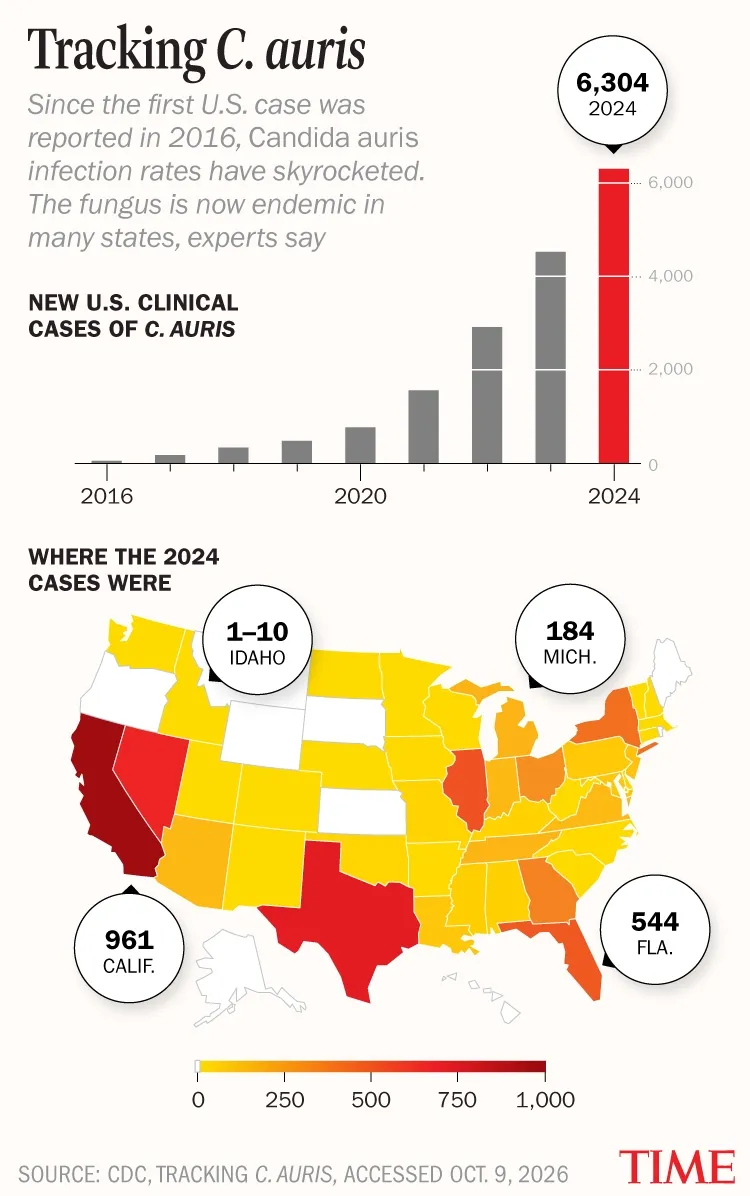
The raw facts are grim enough without embellishment. First identified in 2009 in the ear of a patient in Japan, Candida auris tolerates high temperatures and salty environments, clings to skin, hair follicles, hospital floors, and beds designed to repel germs, shrugs off standard disinfectants, and resists antifungal drugs. It has now sickened tens of thousands across more than 80 countries and six continents. The WHO lists it among the highest-priority fungal threats. The CDC reported this summer that over 3,000 people in 27 U.S. states had already been infected this year, with mortality reaching 60% among those infected. Chiller’s verdict on parts of America is blunt: “It’s there to stay.” And auris is merely the loudest signal. Dr. Andrej Spec of Washington University documented the first human infection by a mold previously known only to damage trees in 2021; two more U.S. cases followed within five years. In October, the CDC flagged a brain-attacking mold whose cases have jumped fourfold in two years, killing up to 70% of those it infects, including healthy people. Researchers believe auris evolved heat tolerance in marine ecosystems as the planet warmed, and it can now survive at 107°F. Meanwhile, antifungal overuse in medicine, agriculture, and livestock farming is breeding resistance, and an estimated 7 million immunocompromised Americans, many kept alive by immune-suppressing therapies for cancer, multiple sclerosis, Crohn’s disease, and rheumatoid arthritis, form a growing host population.
Follow the logic to its commercial and institutional end. Antifungal drug development has never been a profitable franchise, so the pipeline is thin precisely when resistance is thickening. Hospitals now face a pathogen that defeats their cleaning protocols and forces ward closures, which is an unpriced liability no insurer has modeled. Surveillance, new diagnostics, and drug development are advancing, as Spec and his colleagues attest, but they are advancing against a threat whose growth curve is set by warming trends and immunosuppressive prescribing patterns that no public-health agency controls. The loop closes badly: the better medicine gets at saving lives with immune suppression, the larger the susceptible population becomes, and the more valuable any effective antifungal will be. Whoever builds a durable surveillance-and-treatment franchise for invasive fungal disease in the next five years will own a market created entirely by other people’s externalities, and everyone else will be paying rent on it during the next hospital outbreak.