The State Bank of Vietnam is flooding the domestic market with liquidity. Yet foreign investors still face a rigid, procedural maze when trying to move their profits out. The central bank’s dual-track dollar buying program might ease local banking stress. But it does nothing to soften the hard bureaucratic reality of profit repatriation. Every dividend exit remains locked behind a strict compliance checklist. This checklist operates entirely independently of monetary easing. This disconnect represents a critical friction point for foreign capital.
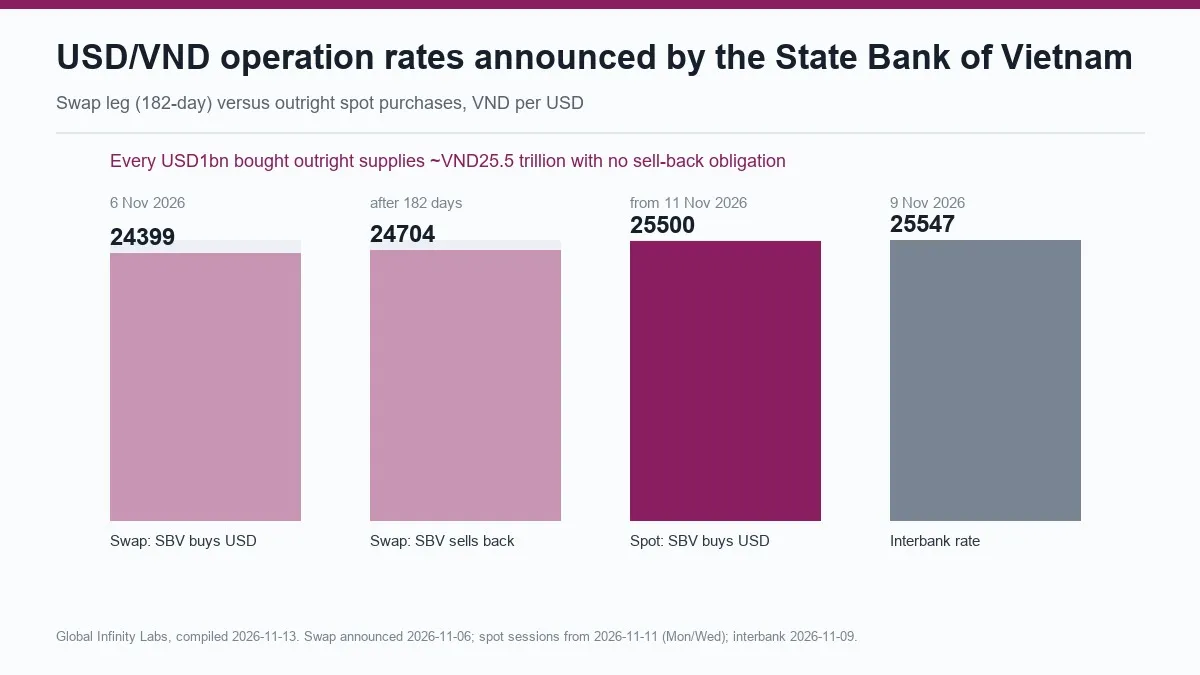
The central bank launched a two-pronged intervention on November 6, 2026. It started with a 182-day USD2 billion foreign exchange swap programme. Under this swap, the bank buys dollars at VND24,399 and commits to selling them back at VND24,704. This mechanism injected nearly VND50 trillion into the banking system on November 9 to cover year-end settlement. On November 11, the central bank began outright dollar purchases at VND25,500 in scheduled Monday and Wednesday sessions. These outright purchases carry no sell-back commitment. They inject permanent liquidity of roughly VND25.5 trillion for every billion dollars bought. While these tools successfully ease domestic funding pressures, they do not alter the rules of the capital account.
The actual rules governing dividend exits sit in Circular 38/2026/TT-NHNN. This circular has been active since August 18, 2026, and remains completely unchanged. This circular requires all capital movements, including profit remittance, to pass through a licensed investment capital account. For foreign investors, the repatriation trigger is strictly procedural and documentary. The fiscal year must be closed, and the enterprise must have fulfilled all state financial obligations. The investor must notify the tax authority at least seven working days before the planned remittance. Crucially, any year showing accumulated losses after carry-forward cannot have its profit remitted at all. Violating these account rules triggers administrative fines of VND30 to 50 million for individuals, and double for organizations.
The central bank manages short-term liquidity and exchange rate drift well. Yet the rigid repatriation framework creates a structural barrier for foreign capital. If investors struggle to exit profits despite favorable domestic liquidity, foreign direct investment inflows could begin to slow. This capital flight risk poses a direct threat to the country’s long-term sovereign credit profile. Policymakers must realize that sustainable financial stability requires not just abundant liquidity, but also the free and predictable movement of capital.