By: Ethan Gallagher
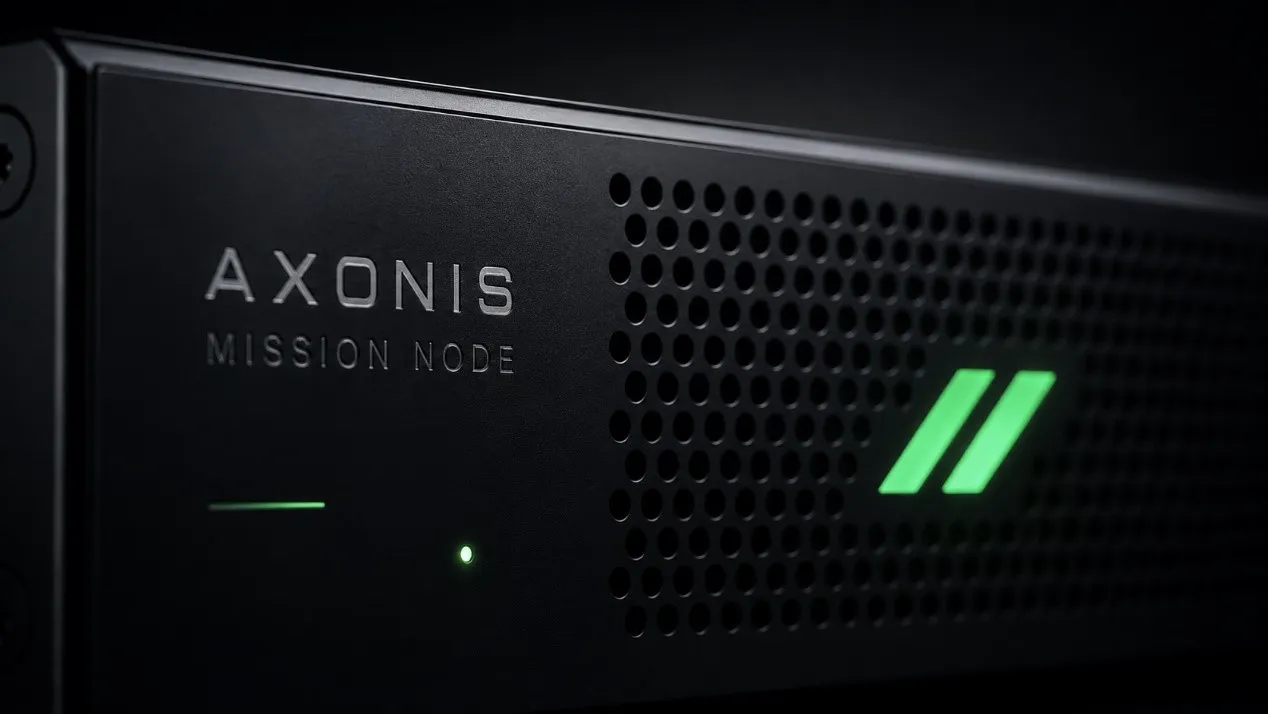
I have spent two decades watching defense contractors bolt the word “edge” onto architectures that still quietly depend on a fat pipe back to a data center. So when Axonis introduced Mission Node on September 9, 2026, from Arlington, Massachusetts, my first instinct was skepticism. My second instinct, after reading the design, was something closer to respect. CEO Todd Barr stated the problem without decoration. Traditional architectures move data to the cloud or a central hub. That creates a critical dependency in contested environments. Commanders lose critical minutes waiting for a link that may never come back. Barr’s answer is to move the intelligence to the mission instead. Local operation is not a fallback mode here. It is the primary mode. That single inversion breaks with how most of the defense software market still builds product. Anyone who has watched a tactical network degrade under electronic attack knows the pain point is real. The spectrum goes dark, the dashboard freezes, and the decision advantage evaporates with it.
The official release facts deserve to be stated plainly, because they are unusually specific. Mission Node is a self-contained, AI-enabled mission intelligence environment built for defense operations at the edge. It connects mission data and AI, generates intelligence, and supports governed decisions locally even when links to centralized infrastructure are cut. Commanders configure the mission, connect their data and AI, surface patterns through prediction, matching, fusion and scoring, then decide and act. The Mission Pack sits at the center of the autonomy claim. Commanders use it to set the data, signals, thresholds, decision flows and effects that define the mission. Human intent enters the framework from the start. The architecture is decentralized. Each node runs alone when disconnected and joins enterprise systems when communications return. Multiple nodes can federate intelligence across authorized joint and coalition environments without sharing or centralizing the underlying sovereign data. The platform is being shown at AUSA 2026 in Washington, D.C., and Axonis itself came out of a U.S. government solutions provider that served the Department of Defense and Intelligence Community.
Now the industry subtext, which the second half of the release makes hard to ignore. Contested environments are no longer the exception. They are the baseline. Any architecture that still needs a clean pipe back to a data center is already compromised the moment the spectrum is contested. Mission Node builds on what Axonis calls decisions-as-data. Every decision is saved as a cryptographically sealed artifact. Those records keep the evidence and context, and they form a training corpus that can improve models and future decisions. This is not audit trail theater. It is the mechanism that keeps human accountability intact when machine speed increases. Retired U.S. Army Colonel Yi Se Gwon, author of The Praxis AI Doctrine, put the principle in sharp terms. Human intent must govern machine execution or the decision is not defensible. Mission Node turns that principle into running code. Federation without data centralization also matters more than the marketing suggests. It is the only realistic way coalition partners share intelligence while keeping sovereign data under their own control.
The supply-chain consequence is colder than any product launch language. Centralized intelligence architectures are becoming liability nodes rather than force multipliers. Mission Node treats the edge as the primary decision surface and the rear link as optional. Every vendor still shipping cloud-first intel tools now has to answer one uncomfortable question: how does your system survive the first day of denied communications? Most cannot answer it honestly. Operators should run a live contested-environment scenario against their current stack, measure how long decisions stay available after the link drops, and then decide whether what they rely on today was built for the Cognitive Age or just assumes the spectrum stays friendly.
Author bio: Ethan Gallagher, a Silicon Valley hardware architect and infrastructure strategist who has spent two decades evaluating defense compute systems, tactical networks, and edge AI deployments for contested environments.