The Jiangsu agreement sounds like a standard diplomatic milestone until you read the fine print. Two chambers shaking hands in a glass-walled headquarters. Press photos staged with practiced symmetry. Yet the real architecture here is far less theatrical.
It runs through membership rolls, fee schedules, and document processing queues. A memorandum signed in November 2026 did not create the relationship between Dubai and Jiangsu province. It formalized a pipeline that already had over 6,650 active Chinese company memberships flowing through it.
Official facts versus the institutional machine underneath
The press materials emphasize three cooperation channels: business delegations, market-entry assistance, and B2B matchmaking. The signed names read like who you’d expect. Mohammad Ali Rashed Lootah met Wang Shanhua. They discussed joint participation in events and trade activities.
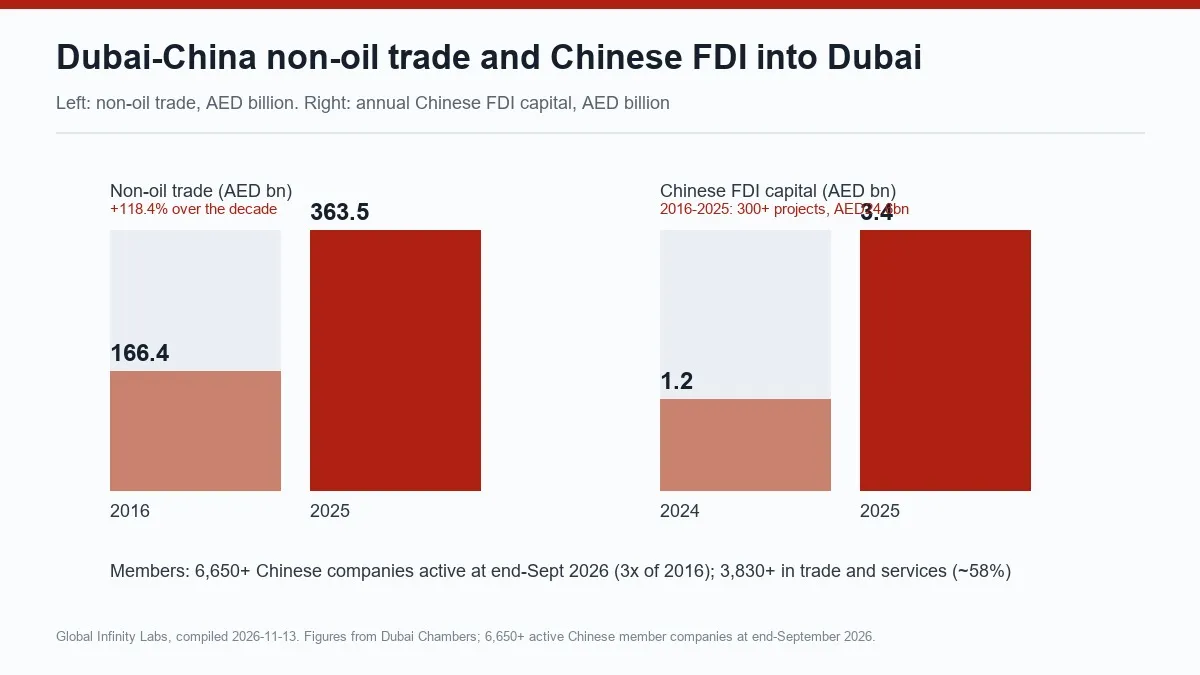
What the announcement omits is the machinery that makes it functional. Dubai Chamber processed membership applications within two hours after payment. Annual fees range from AED 300 for e-traders holding an Intelaq license to AED 2,200 for free zone companies and branches of foreign corporations. Over 3,830 Chinese-member companies sit inside the trade-and-services segment, representing roughly 58 percent of the total 6,650-strong roster.
The 42 percent outside that mainstream includes manufacturing-adjacent firms, technology companies, and investment vehicles. Both governments explicitly target these segments now through provincial-level frameworks. That structural gap between where Chinese members currently concentrate and where policy wants them to land explains the urgency behind agreements like this one.
Trade corridors feeding a measurable institutional loop
Non-oil Dubai-China trade reached approximately AED 363.5 billion in 2025. That figure climbed 118.4 percent from AED 166.4 billion in 2016. By comparison, the Prague partnership clocked in at USD 1.44 billion in non-oil trade per the chambers’ own materials. The China corridor dominates by an order of magnitude.
Dubai International Chamber, one of three constituent chambers, brought 373 international companies to Dubai during 2025. That included 64 multinationals and 309 small and medium enterprises. Its global representative-office network expanded to 38 offices by year-end. The organization received 141 international trade delegations and participated in or organized 235 roadshows across 190 cities.
This infrastructure creates a closed operational loop. Roadshows generate interest. Delegations convert that interest into registrations. Registration data feeds the next round of provincial agreements. The chamber publishes nationality-based membership counts quarterly precisely because these corridor metrics form its operating dashboard. Every new memorandum plugs directly into that tracking system.
I spoke recently with a logistics director who had spent three weeks trying to secure certificate-of-origin stamps for a shipment bound for Shanghai. He eventually enrolled his firm in the Dubai Chamber membership program and received his approval within two hours after payment cleared. His comment captured the practical incentive neatly. The system rewards compliance speed rather than relationship depth.
From merchandise flow to capital deployment
The investment dimension moved later than the trade dimension. Dubai attracted more than 300 foreign-direct-investment projects from China between 2016 and 2025. Total committed capital exceeded AED 24.6 billion across that period.
The acceleration arrived sharply in recent years. Chinese FDI rose from around AED 1.2 billion in 2024 to over AED 3.4 billion in 2025. Non-oil trade grew roughly 23 percent over that same recent window. The lag between trade establishment and investment uptake has now compressed into a synchronized push.
The sector agenda attached to recent engagement reflects this shift. Discussions now center on artificial intelligence, advanced manufacturing, logistics, smart mobility, the digital economy, and venture capital. These topics replace the older commodity-and-merchandise framing entirely.
The Dubai Business Forum China held in Shenzhen in October 2026 gathered 854 Chinese investors and business leaders. Dubai’s delegation numbered 112 senior representatives from public and private sectors, marking the largest overseas business delegation the chamber has ever led.
Enterprises considering Dubai as a regional entry point should treat this membership ecosystem as operational infrastructure rather than a prestige credential. Enroll early if your shipments require documented certificates of origin or commercial attestation. Expect targeted recruitment outreach in your sector as the chamber fills gaps across manufacturing and technology. Map your market-entry costs against the published fee bands. AED 300 for Intelaq holders contrasts sharply with AED 2,200 for free-zone entities. The system is calibrated for volume, not exclusivity.
Where this trajectory lands next
Non-oil trade between the two jurisdictions grew almost 23 percent over the most recent comparable period. Chinese FDI multiplied nearly threefold between 2024 and 2025. Membership expansion accelerated alongside both vectors. Provincial-level memoranda continue multiplying across additional Chinese regions beyond Jiangsu.
The next measurable checkpoint will likely arrive when quarterly membership tallies show a sustained shift away from the current 58 percent concentration in trade and services. That transition signals whether the investment phase has genuinely taken hold or remains confined to announcement cycles.
The pragmatic take-away for any firm evaluating this corridor is straightforward. Track the chamber’s quarterly membership breakdowns by sector, not just headline trade volumes. Watch which provinces receive follow-up memoranda after Jiangsu. Monitor certificate-of-origin processing timelines and fee-schedule adjustments. Those indicators reveal operational momentum long before bilateral trade statistics catch up.