By: Julian Holbrooke
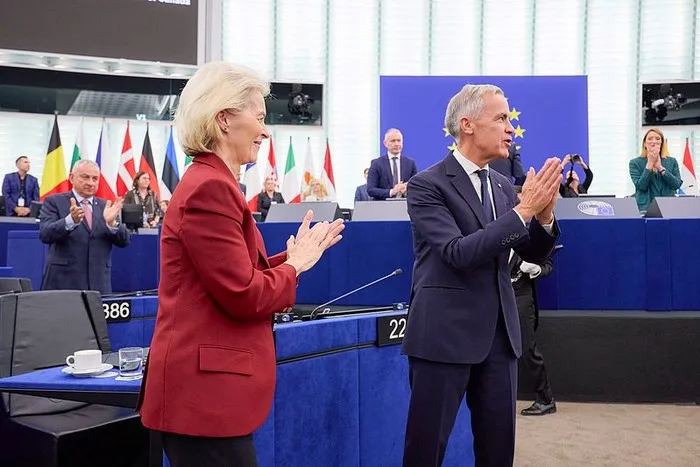
Watch the sequence, not the speeches. On 16 September, Ursula von der Leyen stood before the European Parliament and invited Canada to become the European Union’s first joint member. The next day, Mark Carney answered in Strasbourg, saying Canada and the EU stand together in hard times as well as good ones. That same day, Donald Trump signed a memo cutting Canadian products out of U.S. federal civilian procurement and warned the move could count as a hostile act. Three moves, forty-eight hours. Anyone who has covered alliance politics for a living recognizes this rhythm. This is not diplomacy drifting. This is repositioning under pressure, done in daylight. Washington did not misread the signal. Washington received it exactly as intended.
Start with the official text. Von der Leyen framed the offer as an evolution of the existing Comprehensive Economic and Trade Agreement toward a common space of prosperity and economic security. She stressed the relationship is not aimed at any third party. Carney’s office called it a unique and positive step built on shared strengths, and his statement listed the actual agenda: critical minerals, energy, defence, advanced technology, strategic autonomy and sovereignty. Now read the subtext. Both Ottawa and Brussels face high U.S. tariffs and erratic shifts in American alliance policy. Neither can afford a rupture with Washington. Both can afford to reduce the cost of one. The joint-membership language is clever precisely because it is not full EU accession. It raises the political temperature without triggering treaty mechanics. CETA supplies the ready base. The new vocabulary supplies the leverage. I have sat in enough embassy corridors in Brussels to know what this phrasing means when lawyers draft it carefully. It means optionality. It means the next time Washington threatens tariffs, Ottawa and Brussels want to be holding something Washington wants.
Now the American side of the ledger. Trump’s memo removed Canadian goods from federal civilian buying lists, and he called Canada a terrible trading partner while threatening heavy tariffs or a halt to certain trade flows if he judged the European step malicious. The reporting around this noted the obvious constraint: both Canada and the EU remain heavily dependent on U.S. trade and investment, and any deeper Canada-EU fusion still leaves them exposed in key security domains. That constraint is real. But it misses what actually changed. Traditional transatlantic relations ran on a hierarchy, with Washington at the center of every first phone call. Closer Canada-EU coordination loosens that hierarchy. It does not break the alliance. It changes who talks to whom first, and in alliance politics, call order is power. The procurement ban is an economic instrument, but its target is psychological. Washington is testing whether Ottawa flinches. Strasbourg was the answer to that test, delivered before the memo’s ink dried.
The pendulum has moved, and pretending otherwise is now the naive position. The joint-member proposal and the procurement ban are both on the record, which means neither side can quietly walk back without paying a reputational price. What remains undecided is substance. Talk of critical minerals, defence cooperation and strategic autonomy either produces signed contracts and procurement lines, or it dissolves into another archive of elegant communiques. My read, after two decades of watching these courtships, is blunt: the friction itself is now the fact, and the first concrete Canada-EU defence or minerals contract will matter less for its dollar value than for the day Washington learns it was negotiated without a seat at the table.
Author bio: Julian Holbrooke, an international relations analyst who has covered transatlantic alliance politics for major European daily newspapers for over two decades, specializing in trade statecraft and diplomatic signaling.