By: Ethan Gallagher
Marketing brochures love to talk about autonomous futures, but smoke and burning rubber expose the fiction pretty fast. A quadruped looking pristine in a product catalog means nothing when the chassis hits a collapsed tunnel with zero visibility and 65 percent obstacle density. Most emergency hardware simply collapses under actual thermal loads because spec sheets never account for soot, extreme heat, or structural rubble.
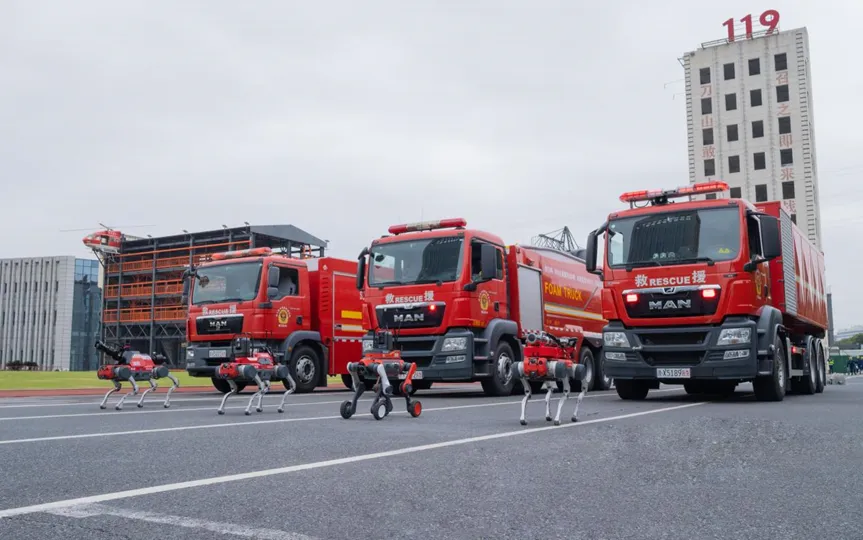
DEEP Robotics frames the problem through a cold lens by demanding a four-stage filter that starts with hardware before touching software or lifecycle costs. The market loves to sell theoretical endurance figures, but the X30 proves what heavy-duty frontline work requires through an IP67 rating, an operating temperature range spanning from -20 °C to 55 °C, and onboard water-spray cooling. It handles a 20 kg rated payload, pushes up to 85 kg, and runs continuously for up to four hours with quick-swappable batteries. Meanwhile, the Lynx M20S trades raw load capacity for velocity, clearing 9 m/s on flat ground alongside 80 cm obstacles via a two-wheel jump, while the compact Lynx S10 stays light enough for a single operator to scout tight structural gaps.
Those platforms only matter if they survive six rigorous technical indicators under load rather than in sterile laboratory conditions. Environmental tolerance demands strict IP66 or IP67 sealing, while terrain tests mandate climbing stairs past 40 degrees and scaling blocks higher than 20 cm while fully weighted down. Perception layers must integrate LiDAR, thermal imaging, dual-spectrum PTZ cameras, and gas sensors to pierce zero-visibility hazmat zones, paired with robust communication links that cut through thick concrete. Real-world drills back up these metrics, from the X30 carrying a water cannon onto the 19th floor of a high-rise to the Lynx M20 dominating levee patrols and state grid cable-fire inspections.
Agencies still buying quadrupeds based on glossy brochure numbers are walking straight into operational failure during the next major incident. Hardware performance sets an absolute ceiling that no amount of post-processing software can fix once the deployment ground turns hostile. Define the terrain, demand the stress test metrics under heavy loads, and verify the deployment logs before signing any purchase order.
Author bio: Ethan Gallagher, a Silicon Valley Hardware Architect and Infrastructure Strategist who evaluates ruggedized robotics for deployment in hazardous industrial environments.