By: Ethan Gallagher
The 128GB framing is not innovation. It is a market reaction that arrived three years late. AI developers have been counting unified memory the same way they used to count GPU cores. That single shift tells you the industry ran up against a ceiling. Every push toward consumer local inference stalled at the same wall. Small RAM. Big models. Cloud fallback. BOSGAME did not invent the wall. They walked up to it and refused to pretend it was invisible. The M5 MAX is a compact workstation built around one assumption. If a developer can run a 70-billion-parameter model locally, they will. They will not ask permission. They will not accept a swap to disk. They will pay for the capacity that keeps them offline. That is the entire pitch. It is also the entire risk. The market only rewards the pitch when everything lines up. Silicon, memory, and price must land on the same day. Miss one and the thesis collapses. The spec sheet is clear enough. What is less clear is whether the supply chain can actually deliver on it. That is where every claim about 128GB as a baseline either holds or breaks.
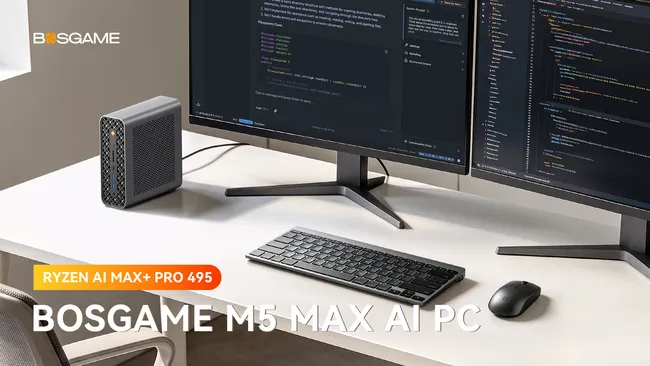
On September 8, BOSGAME previewed the M5 MAX. It is scheduled to arrive between late September and mid-October 2026. The processor is the AMD Ryzen AI Max+ PRO 495. It carries 16 cores and 32 threads. Boost clocks hit 5.2 GHz. Radeon 8065S graphics handle the visual workload. The NPU is rated up to 55 TOPS. Overall AI performance reaches 131 TOPS. The first configuration pairs 128GB of LPDDR5X unified memory with a 2TB PCIe 4.0 SSD. James Cao, general manager at BOSGAME, outlined the goal. Rethink how much computing capability fits into a compact system. He also stated that 128GB is only the beginning. A 192GB memory version with the same 2TB storage is planned for early 2027. The initial 128GB plus 2TB model is expected to sell between 3,600 and 3,800 US dollars. These numbers are not aspirational. They are the spec sheet. They are what the box will ship with when it lands in consumer hands. Every benchmark and every review will be measured against this exact configuration. The M5 MAX sits above the existing M5 platform. It targets AI developers. It targets content creators. It targets software developers and other professionals. Each needs more compute and memory than a conventional mini PC supplies. The positioning is explicit. This is not an upgrade. It is a redefinition of what the form factor can carry. The 131 TOPS figure for overall AI performance is the headline number. The 128GB LPDDR5X figure is the actual differentiator.

The connectivity stack is where the product stops pretending to be a mini PC. OCuLink PCIe 4.0 x4 opens an external GPU path. Dual USB4 carries high-bandwidth peripherals. Dual 10GbE handles local storage arrays. Wi-Fi 7 covers wireless workloads. HDMI 2.1 and DisplayPort 1.4 handle display output. SD 4.0 is included for content creators who still pull footage from cameras. Every one of these ports tells you the chassis was designed as an open workstation. The marketing language calls it a compact system. The port list calls it something different. Buyers who need local model headroom will pay the 3,600 to 3,800 dollar premium without hesitation. Buyers who do not need it will stay with lighter machines priced under 2,000 dollars. The product is not fighting for the middle. It is carving a narrow band of professionals. AI developers, content creators, and software developers are the named audience in the press release. That audience is small enough that pricing power holds. It is also small enough that a misread on volume could sink the whole line. James Cao’s framing points to the same thing. He called 128GB the starting point, not the ceiling. The 192GB version scheduled for early 2027 is the proof. If the 128GB unit sells well, the 192GB unit becomes a margin play. If the 128GB unit stalls, the 192GB unit never gets ordered. The order of operations matters. Everything hinges on the first SKU shipping on schedule at the right price. The commercial loop is already drawn. Memory capacity has become the practical bottleneck for local large-model work and heavy creative multitasking. BOSGAME is selling the capacity first and the form factor second. That inversion is the entire strategy. The only number that decides success is volume. How many of those high-memory units actually ship once the price is public. If the number is five thousand, the line dies. If the number is fifty thousand, the line defines the next two years of mini PC design. That is the entire game. No benchmark will change the math. No review will save a misread SKU. Volume is the only number that will be argued about after the price lands on a retail shelf.
Memory is the real bottleneck here. Every gigabyte of LPDDR5X unified memory buys real local-model headroom. That arithmetic has not changed since the Ryzen AI series launched. The 128GB configuration is defensible only if AMD can supply the Ryzen AI Max+ PRO 495 chip in volume. It is also defensible only if the memory supplier can deliver LPDDR5X at a stable price. If either link slips, the 192GB version planned for early 2027 slips with it. The 3,600 to 3,800 dollar price assumes yield stability across both components. It also assumes no major memory tariff between preview and shipping. The M5 MAX is not a supply-chain win yet. It is a supply-chain bet. The machine ships in late September 2026. The market answers before the end of that year. Whoever can source LPDDR5X in quantity at that price point owns the 128GB tier for the next generation. Everyone else will be priced out by 2027. That is the only assertion that matters. The marketing will fade. The benchmarks will be argued about. The supply chain will hold or it will break. And the answer will be known before the 192GB version ever reaches a retail shelf. Every dollar of margin in this product will be eaten by either a memory shortage or a memory surplus. There is no neutral outcome. The 128GB tier either becomes the floor for local AI workstations, or it becomes a niche. Both are decided before 2027. The M5 MAX is the first move. The supply chain is the only opponent.
Author bio: Ethan Gallagher has spent a decade designing consumer silicon and infrastructure roadmaps in Silicon Valley. He analyzes hardware supply chains, processor economics, and the intersection of AI workloads with form-factor constraints.