BASSETERRE, KN – 10/03/2026 – (SeaPRwire) – As digital assets, traditional banking services, and global payment networks keep developing separately, individuals and businesses operating internationally often deal with a disjointed financial ecosystem. To tackle this issue, the VALYGO platform has formally rolled out, introducing a cohesive financial space designed to merge various financial capabilities into one integrated system.
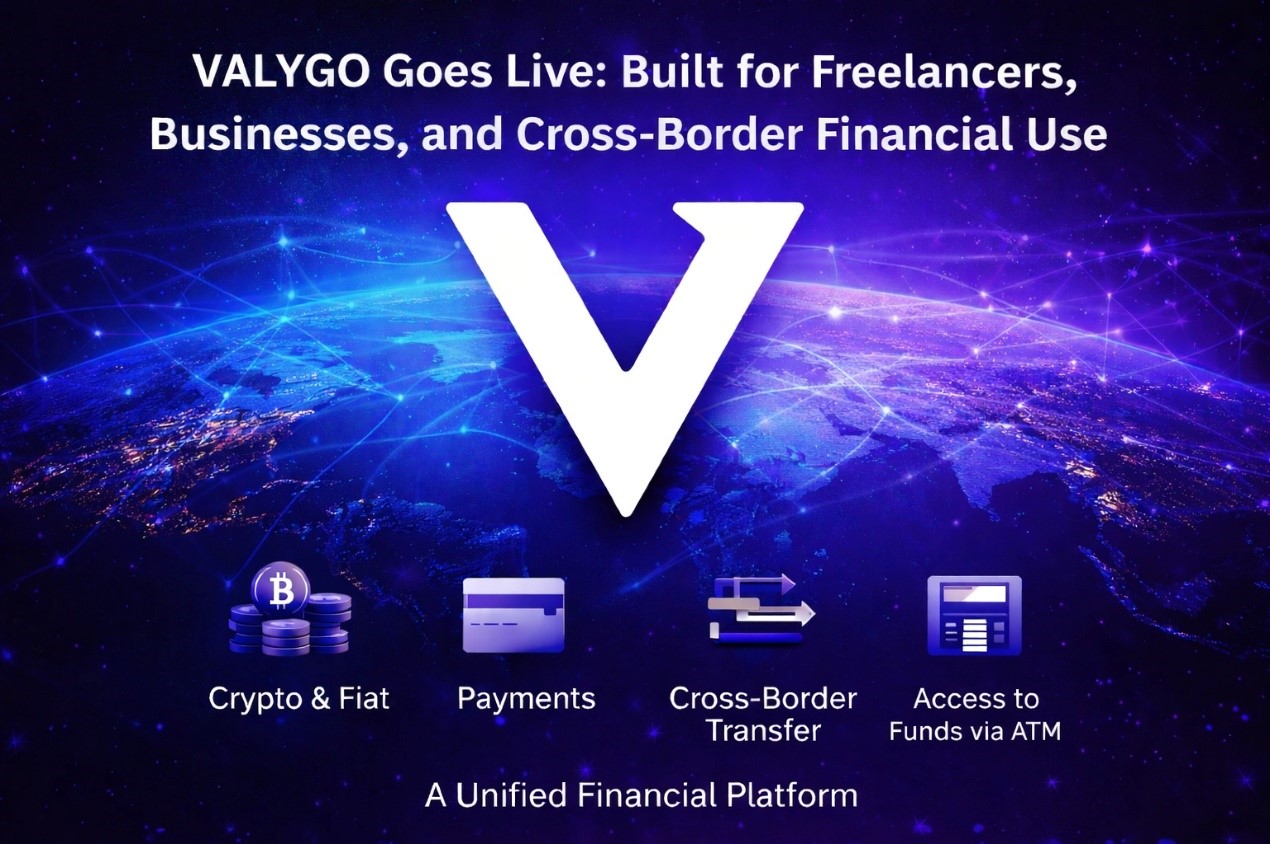
Today’s financial transactions often demand that users depend on distinct systems for crypto asset management, fiat currency dealings, payment handling, and cross-border money transfers. This disjointed setup can slow down financial processes, add administrative hassle, and raise operational inefficiencies for professionals and businesses operating across different countries. VALYGO steps into this arena aiming to streamline financial workflows by uniting these features within a single organized platform.
A Platform Built Around Real-World Financial Workflows
Instead of concentrating on one specific financial service, VALYGO was built around how people and businesses handle money in actual situations. The platform lets users work within a linked account system where multiple financial functions can exist side by side and interact seamlessly.
Via the platform, users can manage digital assets alongside approved fiat services, carry out card-based transactions both online and at brick-and-mortar stores, and perform cross-border transfers without needing multiple external tools. Also, supported ATM access offers an additional way to access funds.
By combining these services into a single platform, VALYGO seeks to minimize the need for users to switch between various tools and platforms, fostering more consistent daily financial operations.
Catering to Cross-Border Financial Users
The platform was developed with globally active users in focus. Freelancers billing clients overseas, remote workers earning income from various regions, and businesses with clients in different countries often need financial infrastructure that can handle complex payment streams.
VALYGO’s design aims to meet these needs by offering an operational space where payments, asset management, and account access all work within one system. People who often use both crypto and traditional financial services may also benefit from the platform’s integrated setup.
Flexible Account Tiers for Varied Operational Requirements
Understanding that users operate at different scales, VALYGO provides multiple account tiers tailored to suit various levels of financial activity. This organized approach lets users pick an account type that matches their operational needs.
Basic entry-level accounts are available for users with simpler needs, while higher-tier accounts offer enhanced features and may involve engagement with the VYO ecosystem component. By providing tiered access, the platform aims to be scalable without forcing the same requirements on all users.
VYO’s Role in the Platform Ecosystem
Inside the VALYGO ecosystem, VYO acts as a utility element tied to platform usage. Its applications include granting access to specific account tiers, supporting staking activities, and connecting token utility to platform features.
Instead of existing separately from the platform, VYO is built to be part of the larger ecosystem infrastructure, aligning user engagement with the system’s operational design.
Moving From Development to Live Usage
Now that the platform is live, users can interact with VALYGO in real-world operating conditions. The launch marks the shift from development and system design to actual use.
Although future updates and enhancements may continue as the platform grows, the current version lays the groundwork for users to access a financial space that combines digital assets, payment tools, and approved fiat services into one integrated system.
A Unified Operational Layer for Modern Finance
VALYGO does not see itself as a replacement for traditional banks, a trading platform, or just a crypto wallet. Instead, it positions itself as an integrated operational layer that connects various financial functions—from crypto access and approved fiat services to payment infrastructure and account management—within a single unified space.