OMP Extends UnisonIQ with Agent Library and Agent Studio: AI Agents that Produce Executable Supply Chain Plans ACN Newswire

OMP Extends UnisonIQ with Agent Library and Agent Studio: AI Agents that Produce Executable Supply Chain Plans

ANTWERPEN, BELGIUM, Nov 3, 2026 - (ACN Newswire via SeaPRwire.com) - OMP, a leader in supply chain orchestration, today extended UnisonIQ, the AI framework in its Unison Planning™ platform, with the Agent Library of ready-to-deploy AI agents and Agent Studio, where companies build their own. The agents run on the optimization engines in Unison Planning™ and produce executable supply chain plans. Bekaert is among the early adopters of UnisonIQ.Supply chain organizations face board-level pressure to show progress on AI, but many struggle to move beyond experiments. Generic AI models and decision-intelligence tools miss the industry-specific context and semantics that planning depends on, while planning tools with an AI layer on top lack reasoning depth. Both can produce a confident answer that ignores real-world constraints such as shelf life, co-products, and shared capacity.In UnisonIQ, by contrast, each agent works from a reality-based digital twin of the customer's own supply chain and calls on the optimization engines in Unison Planning™, so the plan changes it prepares hold up in practice. Planners work with the agents through Unison Companion, the AI assistant in the platform. A planner asks a question in plain language, and Companion assigns the right agents to answer it or to prepare a plan change.Bekaert: comparing S&OP scenarios in plain languageBekaert, a leader in steel wire transformation and coating technologies, uses Unison Companion in the sales and operations planning (S&OP) process of its Energy Transition subdivision. Planners describe the scenario they want to test in plain language, such as adding capacity at bottlenecks while demand rises. UnisonIQ then models it, runs it, and compares it with the current plan. Bekaert is now extending Unison Companion to demand planning in its Steel Wire Solutions division, where planners use it to challenge their forecast."Our planners can describe different scenarios in plain language and compare the modeled outcomes with the current plan. This helps keep our S&OP discussions focused on evaluating options and making informed decisions," said Filip Lanckmans, Global Supply Chain Manager at Bekaert.The Agent Library covers supply, demand, and data management, so teams can put ready-to-deploy agents to work. With Agent Studio, companies build their own agents on the same digital twin and optimization engines. Whether agents are self-built or ready-made, each organization decides what an agent may decide, execute, or escalate, and moves toward autonomous planning at its own pace."Most companies don't struggle to start with AI. They struggle to scale it," said Tom Wouters, Chief Product Officer at OMP. "An agent is only as good as the engine behind it. UnisonIQ agents run on the same optimization engines behind our customers' plans, so planners can hand over more work as trust grows and stay in control."For more information about UnisonIQ and how OMP is helping organizations achieve scalable, trusted AI adoption, visit the website.About OMPOMP helps companies facing complex planning challenges to excel, grow and thrive by offering the best digitized supply chain planning solution on the market. Hundreds of customers in a wide range of industries - spanning consumer goods, life sciences, chemicals, metals, paper and packaging - benefit from using OMP's unique Unison Planning™.Solution and product inquiriesContact OMP+32 3 650 22 11Media inquiriesKira Perdue (Carabiner)SOURCE: OMP Copyright 2026 ACN Newswire via SeaPRwire.com. All rights reserved. www.acnnewswire.com
More
UNMOVE Launches Seven-Day Pass and Short-Cycle Personal Training for APEC Visitors in Shenzhen ACN Newswire

UNMOVE Launches Seven-Day Pass and Short-Cycle Personal Training for APEC Visitors in Shenzhen

SHENZHEN, Nov 3, 2026 - (ACN Newswire via SeaPRwire.com) - UNMOVE, the 10,000-square-metre sports and recovery centre in Shenzhen's Xili district, today announced a seven-day pass and two short-cycle personal training packages, developed for the international professionals in the city for APEC 2026.The seven-day pass gives full access to the facility. The training packages run 3 sessions over 7 days, or 9 sessions over 21 days. All three are offered at introductory rates through the APEC period and are available to every member, Chinese or international.APEC 2026 has brought several thousand delegates, executives and advisers to Shenzhen, most of them for one to two weeks. Their days are scheduled from morning to evening, and the hour they would normally spend training is usually the first thing to be cut. Many of them train daily at home and intend to keep doing so here."People who train every day don't stop when they travel," said Choc, chief executive officer of UNMOVE. "What stops is their access. They land in a new city, the hotel gym has three machines and a thirty-minute limit, and by the seven day the habit is gone. A monthly membership doesn't solve that for someone who is here for nine days."The shorter cycle is also a response to how visitors use coaching. A standard personal training block of 20 or 30 sessions assumes a member who will still be in the same city in three months. For a guest on a two-week stay, most of that block goes unused, and the sessions that do happen are compressed into the last few days."9 sessions in 21days is not a smaller version of a normal package," Choc said. "It's the right size for someone with a deadline. They can train every other day, and the last session still means something."The seven-day pass covers the whole building rather than a single zone: more than 300 pin-loaded machines from Panatta, Life Fitness, Precor, Nautilus, Freemotion and Newtech; a 200-square-metre cinema cardio room; a Les Mills studio; a 40-degree hot yoga room; a 500-square-metre HYROX-certified training area; a competition-spec boxing ring and a pickleball court; and a recovery wing with liquid nitrogen cryotherapy, medical-grade hyperbaric oxygen and an infrared sauna.On pricing, Choc was direct. "We set one price list and applied it to everyone," he said. "Visitors shouldn't pay more than the people who live here, and the people who live here shouldn't find out that a guest from out of town got a better deal. It's the same card, the same rate, the same terms."UNMOVE opened in Xili with a membership model built on monthly billing, published pricing and no commission at the front desk. The centre says the short-cycle products follow the same principle: a member who wants to leave can leave, and a visitor who wants three days should not have to buy a year.The seven-day pass and both training packages are available at the UNMOVE front desk in Xili and through the centre's official booking channels from today. Pricing details and terms are available on request.About UNMOVEUNMOVE is a 10,000-square-metre sports and recovery centre in Shenzhen's Xili district. Its facilities include a 300-machine training floor, a cinema cardio room, a Les Mills studio, a hot yoga room, a HYROX-certified training area, a boxing ring, a pickleball court and a recovery wing offering cryotherapy, hyperbaric oxygen and infrared sauna. The centre operates on monthly membership, published pricing and a three-layer physical assessment renewed each month.Media contactBrand: UNMOVEContact: Media teamEmail: zhaochuang@unmove.cn Copyright 2026 ACN Newswire via SeaPRwire.com. All rights reserved. www.acnnewswire.com
More

11 Financial Institutions Join HKMA Expert Group on Agentic Finance

Hong Kong, Nov 3, 2026 - (ACN Newswire via SeaPRwire.com) - On 2 November 2026, the Hong Kong Monetary Authority (HKMA) announced the launch of Project SAGE to support the responsible development and adoption of agentic finance in Hong Kong. SAGE stands for “Securing Agentic Finance with Governance and Enablement”. The project will focus on enabling practical applications of agentic finance.In order to bring together expertise and perspectives, the HKMA established the Agentic Finance Expert Group, which consists of relevant stakeholders like financial institutions, technology service providers, academia, and professional service firms.The members of the Agentic Finance Expert Group are as follows, based on the Annex issued by the HKMA on 2 November 2026:Financial institutions: Adyen, Anchorpoint Financial, Ant International, Bank of China (Hong Kong), Mastercard, Payment Cards Group, Standard Chartered Bank (Hong Kong), HSBC, UnionPay International, Visa Hong Kong, and WeChat Pay Hong KongTechnology service providers: Amazon Web Services, Animoca Brands, Circle Hong Kong, Google Cloud, JINGDONG Technology, SHOPLINE, and Tencent CloudProfessional service firms: AIFT, Clifford Chance, and PwCAcademia: Professor Allen Huang of HKUST Business School Copyright 2026 ACN Newswire via SeaPRwire.com. All rights reserved. www.acnnewswire.com
More
DesignInspire opens on 18 November with free admission to the public on 19-21 November ACN Newswire

DesignInspire opens on 18 November with free admission to the public on 19-21 November

Hong Kong, Nov 3, 2026 - (ACN Newswire via SeaPRwire.com) - Supported by the Cultural and Creative Industries Development Agency (CCIDA) as lead sponsor and organised by the Hong Kong Trade Development Council (HKTDC) and co-organised by the Hong Kong Design Centre (HKDC), the latest DesignInspire takes place from 18 to 21 November at the Hong Kong Convention and Exhibition Centre (HKCEC). The exhibition offers free admission throughout its four-day run, opening exclusively to trade buyers on 18 November and to both trade buyers and the public from 19 to 21 November.Under the theme "Wander & Wonder", the 2026 edition of DesignInspire encourages visitors to embark on a journey of exploration guided by curiosity, discovering inspiration through interactions across different cultures and creative disciplines. Highlight exhibitions include "ABITO/HK" by Salone del Mobile.Milano, specially infused with Hong Kong design elements and being shown in the city for the first time; "Cabinets of Wonders", a cross-cultural creative showcase curated by emerging artist Chilai Howard; "Breathing in Motion", an immersive installation created by renowned Swiss design studio atelier oï; and "House of Lumière", curated jointly by lighting design master Tino Kwan and interior designer CM Jao. Through a diverse range of exhibitions and interactive experiences, the fair demonstrates how design connects culture, creativity and innovation, inspiring ideas among trade buyers and transforming creative design excellence into commercial opportunities through elevated customer experiences.Swiss design studio atelier oï presents the immersive installation "Breathing in Motion". It offers visitors an immersive spatial experience, encouraging them to explore the connections between design, perception and the surrounding environmentHKTDC Associate Executive Director Anna Cheung said: "Design is not only a form of creative expression, but also a powerful force driving cultural exchange, brand development and business innovation. Since its launch, DesignInspire has served as an international platform for design exchange, fostering connections between creative industries and the business community. This year's fair brings together more than 200 exhibitors from 17 countries and regions, including creative organisations from Hong Kong, the Chinese Mainland, Italy, Switzerland, France, Germany, Spain, Belgium, the Czech Republic, the United States, Malaysia, Vietnam, Thailand, and beyond, showcasing works and projects by more than 320 internationally renowned designer brands and demonstrating the diversity and vibrancy of creative design from around the world. Through exhibitions, forums, innovation workshops, business matching, advisory services on intellectual property for the creative industries and networking activities, DesignInspire builds connections and helps creative ideas reach the market. This supports the direction set out in Hong Kong's first Five-Year Plan to develop Hong Kong into an East-meets-West centre for international cultural exchange, reinforcing the city's position as Asia's hub for creative design and business exchange."ABITO/HK by Italy's Salone del Mobile.Milano makes its debut in DesignInspireThis edition of DesignInspire will showcase a collection of world-class design projects, headlined by "ABITO/HK" – a special pavilion presented for the first time in Hong Kong by the Italian Ministry of Foreign Affairs and International Cooperation. Supported by the CCIDA as the lead sponsor and organised by the HKTDC, "ABITO/HK" is produced and promoted by the Italian Ministry of Foreign Affairs, presented in Hong Kong in collaboration with Salone del Mobile.Milano, in partnership with the Consulate General of Italy in Hong Kong and Macao, and curated by the world-renowned design studio Palomba Serafini Associati.Infused with a distinct Hong Kong perspective, the exhibition juxtaposes iconic furniture and design pieces from Italy and Hong Kong. Tracing their evolution through a chronological lens, it highlights the development of design aesthetics and lifestyle sensibilities in both regions. The Italian exhibition showcases collectible, iconic designs from prestigious brands such as Giorgio Armani, Gucci, Versace, Max Mara, Porro, Cassina, Kartell, B&B Italia, Memphis and selected garments come from the historical fashion archive of the Quinto-Tinarelli Collection; while the Hong Kong showcase presents signature works by contemporary creative pioneers, including Alan Chan, Douglas Young, Elaine Ng, Freeman Lau, Henry Steiner, William Lim and more.Beyond offering global high-end buyers and collectors a unique opportunity to appreciate the finest Italian and Hong Kong design, the exhibition serves as a professional platform for in-depth exchange and business networking, helping buyers discover design treasures rich in cultural heritage.Cabinets of Wonders showcases convergence of Hong Kong and Swiss designHeld concurrently with DesignInspire at the HKCEC, Business of Design Week (BODW) welcomes Switzerland as its partner country this year, with several DesignInspire showcases also featuring strong Swiss creative elements. Curated by Hong Kong artist and curator Chilai Howard, "Cabinets of Wonders" brings together a wide range of creative disciplines, including audiovisual art, typography, ceramics, paper sculpture, metal craftsmanship, watchmaking and interactive installations from 20-25 designers, artists and brands from Hong Kong and Switzerland, uncovering how design transcends geographic and cultural boundaries, transforming creativity, memories and values into a common language. Participating parties include legendary watchmaker Parmigiani Fleurier, award-winning Swiss graphic designer Dafi Kühne, furniture designer Adrien Rovero, who has collaborated with brands such as Hermès, renowned Hong Kong designer and artist Freeman Lau, acclaimed music producer Edward Chan, kinetic installation artist Joseph Chan, iconic Swiss furniture brand Vitra, and design studio BIG GAME. Inspired by the harmonious relationship between nature and the surrounding environment embodied by Swiss Alpine chalets, the exhibition space offers an immersive environment that invites visitors to experience the connections and resonance between Hong Kong and Swiss design cultures.Breathing in Motion offers an immersive spatial experience through lightAnother highlight is presented by internationally acclaimed Swiss design studio atelier oï with the support of Tribe22. Known for its multidisciplinary approach combining architecture, craftsmanship and scenography, the studio specialises in innovative applications of natural materials such as wood, leather, metal and textiles in designs. The company's portfolio includes long-standing collaborations with leading international fashion, jewellery and furniture brands, including Bulgari, Louis Vuitton, Rolex, Moroso and Rimowa. At DesignInspire, atelier oï presents the immersive installation "Breathing in Motion". The Oïphorique lighting collection, whose rhythmic movements resembling breathing actions elegantly merge light, material and motion, serves as the heart of the showcase. Enhanced by curved mirrored structures that create layers of reflections and light effects, the installation offers visitors an immersive spatial experience, encouraging them to explore the connections between design, perception and the surrounding environment.House of Lumière reshapes spatial aesthetics with lighting solutions"House of Lumière", jointly curated by lighting maestro Tino Kwan and interior designer CM Jao, brings together leading lighting brands from Hong Kong, France, Italy, Spain and the Chinese Mainland. Through a fusion of lighting artistry, spatial design and innovative technologies, the pavilion presents over 80 designer lighting creations, including works by Steve Leung and André Fu, and pieces from Davide Groppi, DCW éditions, Vibia and more. The exhibition highlights emerging trends and the applications of lighting design across residential, cultural and commercial environments.International brands gather at DesignInspireThe American Hardwood Export Council (AHEC) will participate for the first time, showcasing the boundless aesthetic and creative possibilities of sustainable hardwoods in contemporary design. The participation of AHEC further reinforces Hong Kong’s role as a regional hub for creative design exchange and enhances links with the global design community. In addition, the DesignInspire Boutique is a dedicated retail zone where visitors can purchase art pieces and design products created by designers and artists from around the world, including works from well-known brands such as Lehni, MEMPHIS, LEEVIDA, SOULITE, SEEHOW Group, award-winning local design brand Get the Pong and 3D-printing design studio noodo lab.Beyond bringing together leading global design brands, DesignInspire is committed to nurturing design talent and encouraging industry innovation. The Hong Kong Design Institute (HKDI) and The Hong Kong Polytechnic University will present works by the next generation of design talent, while the DFA Design for Asia Awards will showcase a selection of award-winning works. These platforms provide broader exposure and development opportunities for outstanding designs while fostering exchange and collaboration across the industry and empowering industry development.Complimentary business matching and intellectual property advisory servicesThrough its business matching service and organising buyer missions, DesignInspire actively connects global buyers with design brands, helping businesses identify innovative design solutions tailored to their needs while enhancing customer experiences and creating commercial value. Design 31 FHKI also offers intellectual property advisory services, providing professional support to creative talent seeking to commercialise their ideas and bring innovative concepts to market through the exhibition. These services help facilitate the conversion of creative achievements into commercially promising projects.The exhibition features InnoTalks, bringing together internationally renowned designers and industry experts to share their insights. Besides, a series of creative workshops will be held to enable participants to learn new craft techniques and design concepts. Monotype serves as DesignInspire's creative typography partner. By using selected Monotype typefaces, visitors can create personalised typographic artworks and discover how typography shapes aesthetics and creative expression.Meanwhile, three major HKTDC events, namely the Business of Intellectual Property Asia Forum, HKTDC Entrepreneur Day (E-Day) and Start-up Express International, will run alongside DesignInspire on 19 and 20 November at the HKCEC. Bringing together experts from the innovation and technology, intellectual property and entrepreneurship sectors, these events aim to promote cross-sector collaboration and create new business opportunities. Participants can utilise the business matching offered by the HKTDC to connect with companies, creative talents and potential partners from around the world, exploring opportunities to cooperate.Concurrently, the flagship Business of Design Week (BODW) 2026 Summit, organised by the Hong Kong Design Centre, will take place from 18 to 20 November at Hall 3C of the HKCEC. Bringing together more than 50 creative leaders and business decisionmakers from around the world, the summit will explore six key themes while promoting international design exchange and cross-sector collaboration.DesignInspire detailsDate:18-21 November 2026 (Wednesday to Saturday)18 November (exclusively open to trade visitors)19-21 November (open to trade and public visitors)Time:18 November 2026 (Wed) 2pm-7pm19-20 November 2026 (Thu to Fri) 9:30am-7:30pm21 November 2026 (Sat) 9:30am-7pmVenue:Hong Kong Convention and Exhibition Centre Hall 3D-E Admission:Free admissionWebsite:https://designinspire.hktdc.com/en/Photo download: https://bit.ly/4iyWCcE Organised by the Hong Kong Trade Development Council (HKTDC) with the Cultural and Creative Industries Development Agency (CCIDA) as lead sponsor and co-organised by the Hong Kong Design Centre (HKDC), DesignInspire will take place from 18 to 21 November at the Hong Kong Convention and Exhibition Centre "ABITO/HK", presented by Salone del Mobile.Milano in Hong Kong for the first time, features iconic Italian and Hong Kong furniture and design pieces. The exhibition traces the evolution of lifestyles, living spaces and aesthetic values in both places through a timeline-based narrative, creating cross-cultural interactions that highlight shared aesthetic pursuits alongside distinctive cultural identities Curated by Hong Kong artist and curator Chilai Howard, "Cabinets of Wonders" brings together a wide range of creative disciplines, including furniture design, audiovisual art, typography, ceramics, paper sculpture, metal craftsmanship, watchmaking and interactive installations from 20-25 designers, artists and brands from Hong Kong and Switzerland, exploring how design transcends geographic and cultural boundaries, transforming creativity, memories and values into a common language "House of Lumière", jointly curated by lighting design master Tino Kwan (left) and renowned interior designer CM Jao (middle), combines lighting art, spatial design and innovative lighting technologies to demonstrate the application and future development of lighting design across lifestyle, cultural and commercial settings. It will showcase lighting products from international brands, including FOCUS 5 BLACK by DCW éditions (right)WebsitesMedia enquiriesPlease contact the HKTDC’s Communications & Public Affairs Department:Raconteur PR:Betsy TseTel: (852) 9742 7338 Email: betsytse@raconteur.hkMolisa LauTel: (852) 6187 7786Email: molisalau@raconteur.hkHKTDC Communication and Public Affairs Department:Katy WongTel: (852) 2584 4524Email: katy.ky.wong@hktdc.orgChristy LeeTel: (852) 2584 4369Email: christy.wn.lee@hktdc.orgHKTDC Media Room: https://mediaroom.hktdc.com/enAbout HKTDC The Hong Kong Trade Development Council (HKTDC) celebrates its 60th anniversary this year. The HKTDC is a statutory body established in 1966 to promote, assist and develop Hong Kong's trade. With over 50 offices globally, including 13 in Chinese Mainland, the HKTDC promotes Hong Kong as a two-way global investment and business hub. The HKTDC organises international exhibitions, conferences and business missions to create business opportunities for companies, particularly small and medium-sized enterprises (SMEs), in the mainland and international markets. The HKTDC also provides up-to-date market insights and product information via trade publications, research reports and digital news channels. For more information, please visit: www.hktdc.com/aboutus. Follow us on @hktdc and LinkedInAbout Cultural and Creative Industries Development Agency (CCIDA)The Cultural and Creative Industries Development Agency (CCIDA), formerly known as Create Hong Kong (CreateHK) since 2009, was established in June 2024. CCIDA is a dedicated office under the Culture, Sports and Tourism Bureau of the Government of the Hong Kong Special Administrative Region (HKSAR Government) to provide one-stop services and support to the cultural and creative sectors with a mission to foster a conducive environment in Hong Kong to facilitate development of the arts, culture and creative sectors as industries. CCIDA’s strategic foci are nurturing talent and facilitating start-ups, exploring markets, promoting cross-sectoral and multi-disciplinary collaboration, promoting industrialisation of the arts, culture and creative sectors under the industry-oriented principle, and fostering a creative atmosphere in the community, thereby reinforcing Hong Kong as Asia’s creative capital and our positioning as the East-meets-West centre for international cultural exchange.Disclaimer: The Government of the Hong Kong Special Administrative Region provides funding support to this project only and does not otherwise take part in such funded activities/projects. Any opinions, findings, conclusions or recommendations expressed in this publication and relevant materials/events (or by members of the project teams) are those of HKTDC only and do not reflect the views of the Government of the Hong Kong Special Administrative Region, the Culture, Sports and Tourism Bureau, the Cultural and Creative Industries Development Agency, the CreateSmart Initiative Secretariat or the CreateSmart Initiative Vetting Committee.About Business of Design WeekBusiness of Design Week (BODW), Asia’s premier annual event on design, innovation and brands since 2002, is organised by Hong Kong Design Centre and gathers some of the world’s foremost design masters, brand leaders and entrepreneurs from Hong Kong as well as overseas, driving discourse on the value of design and innovation to inspire global audiences and explore new business opportunities. Copyright 2026 ACN Newswire via SeaPRwire.com. All rights reserved. www.acnnewswire.com
More
Saudi Arabia’s HUMAIN Signed the Deals. The Switchgear Decides What Runs ACN Newswire

Saudi Arabia’s HUMAIN Signed the Deals. The Switchgear Decides What Runs

HONG KONG, Nov 3, 2026 - (ACN Newswire via SeaPRwire.com) - At LEAP 2026, which ran in Riyadh from 31 August to 3 September, HUMAIN disclosed project agreements worth more than US$15 billion. The list ran the length of the stack: AMD for chips, AWS for a cloud region, Microsoft for a distribution channel for an Arabic model, Qualcomm for an end device, Adobe as the first foreign tenant on locally hosted compute, Together AI for 250 megawatts, Applied Intuition for autonomous trucks, SLB for oilfield data. A single company, eighteen months old in its current form, signed across power, silicon, models and applications in four days.That is the action. Everything interesting about Saudi Arabia's artificial intelligence programme follows from what happened next, which is the part the announcements do not cover.The country had 68 megawatts of data centre capacity in 2021. By the first quarter of 2026 it had more than 467 megawatts, according to the Saudi Press Agency. A report from the commercial office in Jeddah put the count at 60 data centres by the second quarter of 2026, with planned capacity of 3.4 gigawatts. Read those two numbers together and the shape of the problem becomes visible. Roughly 467 megawatts exist. Roughly 3.4 gigawatts are planned. The ratio between them is the story, and it is a story about transformers, switchgear and cooling water rather than about capital.The Action, and the Size of ItHUMAIN is owned entirely by the Public Investment Fund, the sovereign fund usually described as holding around US$930 billion, and it sits inside the Crown Prince's office rather than under a ministry. Its chief executive is Tareq Amin, who ran Rakuten Symphony and before that built a multi-vendor telecom cloud platform at scale. The hire is a statement about what the company is for. It is an operator, not a research lab.The pace it has set is unusual even by Gulf standards. Eleven data centres, capacity coming online at roughly 50 megawatts a quarter, an AWS region promised for December 2026 and a Microsoft region for November 2026, and what the company describes as the first xAI facility outside the United States at 50 megawatts scaling to 500. Amin's own formulation, quoted in regional coverage, is that the objective is to build in 2026 the equivalent of what Saudi Arabia built in twenty years.The ambition is not the interesting part. The interesting part is that HUMAIN chose vertical integration when the obvious alternative was available. The comparison that regional analysts keep drawing is with G42 in the United Arab Emirates, which restructured around Microsoft's equity position, aligned itself with the OpenAI and SoftBank Stargate programme, and leases a substantial share of the capacity it sells. HUMAIN owns the data centres, contracts the chips, hosts the models and runs an Arabic consumer product. That is a harder business to execute and an easier one to point at as sovereign.Fourteen Months, Ten SignaturesThe behaviour sequence is where a profile earns its keep. HUMAIN did not announce a strategy and then execute it. It signed in a specific order, and the order reveals what it thought it lacked at each stage.DateActionWhat it securedNovember 2025US-Saudi Investment Forum framework with xAIMore than 500 megawatts of dedicated capacity, plus a US$3 billion stake in xAI's Series EDecember 2025Joint venture with stc through center3A structure rated to 1 gigawatt, HUMAIN holding 51%January 2026Non-binding financing framework with the National Infrastructure Fund, signed at DavosUp to US$1.2 billion for a first 250 megawatt wave at Riyadh and DammamFebruary 2026xAI Series E closesThe equity position becomes real rather than announcedApril 2026Legal documentation moves to final draftingThe financing converts from framework to contractAugust to September 2026LEAP 2026More than US$15 billion across AMD, AWS, Microsoft, Qualcomm, Adobe, Together AI, SLB and Applied IntuitionNovember 2026Microsoft cloud region dueA hyperscaler anchor inside the KingdomDecember 2026AWS cloud region dueA second hyperscaler anchor, on a US$5.3 billion buildoutRead down the first column and a pattern appears. The first four moves are about securing power, capital and a partner with an existing grid footprint. The fifth and sixth are about turning commitments into assets. Only then does the company go shopping for silicon and applications.That sequence is not the sequence a software company would choose. It is the sequence a utility would choose.Why Build the Whole Stack Instead of Renting ItThe case for vertical integration is a case about who captures the margin when compute becomes a tradable commodity, and it rests on three claims that HUMAIN makes explicitly.The first is that sovereign buyers will pay for provenance. A Saudi ministry procuring an Arabic model does not need it to be the best Arabic model in the world. It needs it to be the best Arabic model it can buy on infrastructure inside the country, with evaluation evidence and a documented human-in-the-loop layer. HUMAIN inherited the ALLaM family from SDAIA and has been extending it: broader dialect coverage, a Modern Standard Arabic alignment pass, a Gulf-specific retrieval layer, and a clinical evaluation track aimed at health procurement.The second is that the model layer and the compute layer reinforce each other when both are owned. HUMAIN unveiled a 428 billion parameter Arabic model built with China's MiniMax, trained on more than a trillion Arabic tokens and released as a research preview through its own platform. A model that runs on someone else's cloud is a customer. A model that runs on your own cloud is a product you can bundle.The third is distribution. The Microsoft arrangement puts ALLaM inside Microsoft 365 Copilot and on the Microsoft Foundry platform, which gives the model a channel it could not build. The AWS arrangement puts ALLaM on Amazon Bedrock and HUMAIN's compute fabric on the AWS Marketplace. In both cases the sovereign operator trades exclusivity for reach.There is a cost to that choice, and it is concentration. A company that owns the data centres, contracts the chips, trains the models and sells the applications has four execution risks correlated with each other. If the grid slips, the chips sit in crates, the models have nowhere to train and the applications have nothing to run on.The Gap Between Signed and Switched OnThe gap is quantified in public. Saudi Arabia reported 467 megawatts of operational capacity in the first quarter of 2026 against a planned 3.4 gigawatts. HUMAIN's own disclosed footprint targets 500 megawatts of AI factory capacity across three clusters, one in Riyadh on PIF land, one at NEOM where the giga-project has already built grid capacity and water-cooling assumptions, and one in the Eastern Province close to Aramco's industrial backbone.MeasureFigureStatusNational data centre capacity, 202168 MWoperational thenNational data centre capacity, Q1 2026more than 467 MWoperationalNational planned capacity, Q2 20263.4 GWplannedHUMAIN target footprint500 MW across three clustersin buildHUMAIN and stc joint venturerated to 1 GWstructure agreedDataVolt at NEOM Oxagon100 MW of a 360 MW first phase, 1.5 GW campusconstruction startedxAI capacity in the Kingdom50 MW scaling to 500 MWannouncedCapacity added per quarterabout 50 MWcompany statementThe arithmetic is unforgiving. To reach 3.4 gigawatts from 467 megawatts means adding roughly 2.9 gigawatts, which at 50 megawatts a quarter is 58 quarters, or more than fourteen years. Even if the quarterly run rate triples, the plan is a decade-long build. The 2030 date that appears in most Saudi AI commentary therefore describes a much smaller number than the headline plan implies, and the honest reading is that the plan is a ceiling rather than a forecast.There is a second way to read the same gap, and it is more generous. A gigawatt of planned capacity is not a promise to build a gigawatt. It is a statement that land, grid applications and environmental approvals have been assembled for that quantity, which is a different asset from a building with servers in it. On that reading the 3.4 gigawatts is a pipeline of options, and the 467 megawatts is the part that has been converted. Both readings support the same conclusion about timing: what exists is a small fraction of what is discussed, and the rate of conversion is the variable that decides whether the Kingdom becomes a compute exporter or a compute importer with good marketing.The announced pipeline also has an internal consistency problem that is rarely stated. HUMAIN's 500 megawatt footprint, the 1 gigawatt stc joint venture, the 1.5 gigawatt DataVolt campus at Oxagon and the 500 megawatt xAI commitment are not additive in any simple sense, because several of them describe the same physical capacity under different commercial arrangements. A joint venture rated to 1 gigawatt does not create 1 gigawatt on top of a 500 megawatt target. It describes who owns the meter.What the Structure Cannot DoFour constraints do the real work of setting the timetable, and none of them is capital.The first is high-voltage equipment. Long-lead switchgear and transformer capacity are the operational chokepoint in every Gulf build, and the procurement response has been to buy them the way the company buys GPUs: on multi-year commitments rather than spot orders. That solves availability for the buyer who moves first and makes the constraint worse for everyone else.The second is cooling water. A 500 megawatt campus consumes water at a scale that has to be contracted before construction, not after. NEOM's advantage is that the giga-project already modelled water for The Line and can extend those assumptions. The Riyadh and Dammam sites have to negotiate their own.The third is people. The SAMAI programme targets 100,000 AI specialists by 2030. The global pool of engineers who have actually operated a 100,000 GPU cluster is small, and HUMAIN is competing for it against US hyperscalers and against G42. Amin's hiring has tilted deliberately toward operations and infrastructure engineers rather than model researchers, which is the right tilt for a company whose job is to run AI factories rather than invent them.The fourth is silicon access. The November 2025 export framework and a reported approval for 35,000 advanced accelerators against a pipeline of 600,000 define how fast the compute can arrive. A framework is not a shipment. The gap between the two numbers is the gap between the political relationship and the physical build.The Man Who Runs ItAmin's public statements are worth reading as a set because they are unusually specific about what he thinks the company is not.He has described Saudi Arabia as positioning itself as the "third pillar" of global AI infrastructure alongside the United States and China, and said the commitment to developing compute capacity in the US secures HUMAIN "a strategic foothold". He has also said that "Saudi Arabia will be the first country outside the US and China that will commercialise its own operating system", which is a claim about software, not about megawatts, and it is the more falsifiable of the two. An operating system layer above raw compute is exactly what a national champion would want and exactly what is hardest to ship.The operating claim that matters most is the one about speed: building in 2026 what the country built in twenty years. That is measurable. The measure is the gigawatt count of operational, not announced, capacity, and the second measure is whether the announced offtake materialises. HUMAIN says its NVIDIA Blackwell Ultra cloud is already running government and enterprise workloads with utilisation above 90% and the Ministry of Commerce among the first disclosed users. If that utilisation figure holds as capacity triples, the demand thesis is real. If it falls, the build was a real estate programme with a press release attached.The Money, and Where It Comes FromThe capital stack is worth laying out because it explains why the build has not slowed despite the absence of a commercial customer base large enough to justify it.SourceAmountInstrumentPublic Investment Fund100% of equitysovereign balance sheetNational Infrastructure Fundup to US$1.2 billionnon-binding financing framework signed at Davos, January 2026stc through center3joint venture rated to 1 gigawatt, HUMAIN 51% and stc 49%corporate joint venturexAI Series EUS$3 billionequity stake in the model companyFund managed by BSF Capitalinitial US$2.5 billion for 250 megawatts with Al Moammar, potentially scaling to 1 gigawattinfrastructure fundHUMAIN venture vehicleUS$10 billion target, possibly abovetechnology fundTwo things stand out. The first is that most of this is not project finance in the ordinary sense. A conventional data centre developer raises against contracted offtake, and the lenders underwrite the tenants. Here the sovereign underwrites the developer, and the tenants include ministries. The credit being priced is closer to a sovereign than to a colocation operator, which is precisely how the Kingdom intends to compete on cost of capital against US hyperscale builders.The second is the number of instruments. Equity, a national infrastructure fund, a telecom joint venture, a stake in a model company, a third-party infrastructure fund and a venture arm are six different ways of moving money into the same build. That diversification is a hedge against any single channel stalling, and it is also a fragmentation risk: six instruments mean six sets of terms, six reporting lines and six sets of people who believe they own the schedule.The spending commitment attached to the venture arm has a condition that is easy to miss. Investments are tied to portfolio companies using Saudi compute or bringing staff into the Kingdom. That is a sovereign fund using its chequebook to manufacture demand for the asset it is simultaneously building. It is a coherent strategy and an unusual one: most venture programmes invest to make money, this one invests to fill a data centre.What the Neighbours Are DoingThe Saudi build is easier to judge against the region than in isolation, because the region is running the same play at different speeds with different degrees of vertical integration.The clearest contrast is with the United Arab Emirates. G42 restructured around Microsoft's equity position and aligned itself with the Stargate programme, leasing a significant share of the capacity it sells. That trades autonomy for velocity. The Saudi model trades simplicity for control. The capital comparison favours the UAE on distributed commitments, with Stargate sized at US$500 billion globally and a US$1.4 trillion pledge of investment in the United States over a decade, while Saudi capital is concentrated domestically, at roughly US$77 billion through HUMAIN.The second contrast is less obvious and more instructive. Thailand's Board of Investment reported investment applications breaking 1 trillion baht in the first quarter of 2026, with the digital industry at 873.7 billion baht and data centres accounting for close to nine tenths of that. Thailand is not building a national AI champion. It is processing applications from companies that want to build, using an existing industrial base, an existing grid and an existing regulatory pathway.That difference defines the wager. Saudi Arabia is attempting to build the operator and the infrastructure at the same time, which is why its announcements are larger and its operational megawatts smaller. Thailand is letting other people's operators build on infrastructure it already has, which is why its application numbers look strong and its sovereign AI story does not exist. Both approaches can work. Only one of them produces a company called HUMAIN.What Would Prove the ThesisThree indicators would settle the argument within eighteen months, and all three are public.· Operational megawatts, not announced megawatts. The company discloses capacity additions quarterly. The number that matters is the one that appears in grid interconnection records, not in conference decks.· Utilisation on the live cloud. A figure above 90% on a small base is easy. The test is whether it survives a fivefold increase in supply.· Arabic workload routing. ALLaM inside Microsoft 365 Copilot and on Amazon Bedrock will show, in usage data, whether sovereign Arabic models win on Saudi infrastructure or become a compliance checkbox in a catalogue of American and Chinese alternatives.There is a fourth indicator that is harder to read but more decisive. Saudi Arabia's advantage in this race is land, a domestic market of 33 million people roughly three times the size of the UAE's, and cheaper electricity. Its disadvantage is that hyperscaler relationships and regulatory speed were built elsewhere first. If EMEA and South Asia inference traffic routes through the Gulf, it will route through one hub predominantly. The hub that delivers lower latency, more reliable capacity and better commercial terms takes the traffic, and the terms are set by whoever has spare megawatts first.That is why the switchgear matters more than the signing ceremony. A company can announce US$15 billion of agreements in four days. It cannot compress the lead time on a transformer.Data basisCapacity figures are from the Saudi Press Agency report of August 2026 and from the commercial office report of June 2026, which give 467 megawatts operational and a 3.4 gigawatt national plan respectively; the 2021 baseline of 68 megawatts is from the same SPA report. Deal values and capacities are from the LEAP 2026 summary published by the Chinese Ministry of Commerce's Saudi office, cross-read against trade coverage of the same announcements. The 50 megawatts per quarter run rate, the 500 megawatt target footprint and the 1 gigawatt joint venture rating are company statements reported in regional and industry press. The financing framework of up to US$1.2 billion is non-binding as described in April 2026 coverage, and is treated here as a framework rather than as funds deployed. Estimates of the time required to reach 3.4 gigawatts are arithmetic performed on the published figures, not company guidance.Limitations of the RecordThree limits apply. Announced capacity and operational capacity are reported by different parties on different timetables, so the gap described here is indicative rather than audited. No HUMAIN executive was interviewed; quotations are from published remarks. And the utilisation figure of above 90% is a company claim without a published measurement method.Sources· Saudi Press Agency 🔗 — Saudi data centre capacity from 68 MW in 2021 to more than 467 MW in Q1 2026, August 2026· MOFCOM Saudi office 🔗 — Overview of LEAP 2026 outcomes, September 2026· FWDstart 🔗 — The AI announcements from LEAP 2026 worth knowing, September 2026· AI in Arabia 🔗 — HUMAIN in 2026: anatomy of Saudi Arabia's sovereign AI champion, 17 May 2026· AI in Arabia 🔗 — HUMAIN lines up US$1.2 billion for 250 MW, 28 April 2026· Saudi Compute 🔗 — Sovereign AI in Saudi Arabia: the model versus the UAE model· Thailand Board of Investment 🔗 — Investment applications in Q1 2026 pass 1 trillion baht, 29 April 2026 This article was prepared by the expert team at Global Infinity Labs, drawing on insights and data provided through its MCP data services. About Global Infinity LabsGlobal Infinity Labs is an AI innovation company specializing in MCP data services.Email: support@globalinfinitylabs.com Copyright 2026 ACN Newswire via SeaPRwire.com. All rights reserved. www.acnnewswire.com
More
FWD Group reports strong new business profitability growth ACN Newswire

FWD Group reports strong new business profitability growth

Hong Kong, Nov 3, 2026 - (ACN Newswire via SeaPRwire.com) - FWD Group Holdings Limited (“FWD Group” or “FWD”) today announced strong new business profitability for the nine months ended 30 September 2026.- New business contractual service margin was US$1.4 billion, with year-on-year growth of 22 per cent. Value of new business grew 18 per cent to US$878 million.- New business sales were US$1.95 billion on an annualised premium equivalent (APE) basis, with growth achieved despite a strong comparable period in 2025, particularly in the Hong Kong & Macau reporting segment.- In its first year as a listed company, FWD Group has been recognised for its investor engagement. In October, the company won the Outstanding Listed Companies Award 2026 from the Hong Kong Institute of Financial Analysts and Professional Commentators, received the Excellence Award for First-Year Listed Companies at the Hong Kong Management Association Best Annual Reports Awards 2026 and earned the Gold Award Annual Report Chairman’s Letter (Insurance: Life & Health category) at the 40th International ARC Awards.The double-digit growth in new business profitability reflected a shift in product mix, particularly in Hong Kong where medium-term endowment sales featured heavily in 2025.Structural demand for protection and wealth management solutions continued to evolve, with the FWD Group high-net-worth unit – FWD Private – well established in international cross-border wealth hubs.Huynh Thanh Phong, Group Chief Executive Officer and Executive Director of FWD Group, said, “Disciplined execution, margin expansion, and diversification across our pan-Asian platform are driving profitable growth, as we continue to innovate for customers while delivering strong results to shareholders. A diversified product mix drove excellent new business profitability in Hong Kong, while in Thailand we saw a return to new business sales growth in the last quarter.”In Thailand, the new business results reflected the continued focus on higher-margin product sales and a refreshed go-to-market strategy across distribution channels, partly offset by the impact of a sustained lower interest-rate environment.Strong momentum continued in Japan, where a clear product strategy focused on capturing demand for savings and retirement solutions in a higher interest-rate environment delivered outstanding growth in new business sales and profitability.Growth in the Expansion Markets segment was driven by strong sales of investment-linked products in Singapore, increased sales to affluent customers in the Philippines and a thriving digital channel in Malaysia. FWD Group’s joint venture in Indonesia, BRI Life, continues to lead the market in bancassurance. “Looking ahead, Asia’s long-term protection, savings, and wealth opportunities remain significant, and we are well positioned to help more people to celebrate living with greater financial confidence,” added Huynh Thanh Phong.About FWD Group FWD Group (1828.HK) is a pan-Asian life and health insurance business that serves over 40 million customers across 10 markets, including BRI Life in Indonesia. FWD’s customer-led and tech-enabled approach aims to deliver innovative propositions, easy-to-understand products and a simpler insurance experience. Established in 2013, the company operates in some of the fastest-growing insurance markets in the world with a vision of changing the way people feel about insurance. FWD Group is listed on the Hong Kong Stock Exchange under the stock code 1828. For more information, please visit www.fwd.comFor media inquiries, please contact: groupcommunications@fwd.comSource: FWD Group Holdings LimitedThe unaudited results are for the nine months ended 30 September 2026 and are compared to the same period in 2025. Growth rates are represented on a constant exchange rate (CER) basis. New business sales are new business sales volumes defined as annualised premium equivalent (APE). APE is the sum of 10 per cent of single premiums and 100 per cent of annualised first year premiums for all new policies, before reinsurance ceded. Copyright 2026 ACN Newswire via SeaPRwire.com. All rights reserved. www.acnnewswire.com
More
Chervon Names Thomas Scherer Vice President of Organizational Development – Sales, End User Marketing, and Service ACN Newswire

Chervon Names Thomas Scherer Vice President of Organizational Development – Sales, End User Marketing, and Service

NAPERVILLE, IL, Nov 2, 2026 - (ACN Newswire via SeaPRwire.com) - Chervon names Thomas Scherer Vice President of Organizational Development - Sales, End User Marketing, and Service, effective November 2, 2026, reporting to Matt DeFeo, SVP, Sales, Training, and Recruiting.Scherer brings to Chervon extensive organizational development experience supporting the build-out of large-scale sales teams and end user marketing teams. He is highly experienced in managing employment law, compliance, employee relations, compensation, workforce analytics, training, recruiting, and career development. His world class organizational development skills will be invaluable as the company develops the very best sales, store coverage, end user marketing, and after-sales service teams.Most recently, Tom was Vice President of Human Resources for TTI/Milwaukee where he was responsible for HR and organizational development for a 2000+ person field sales team. Previously, Scherer advanced through a series of HR, training, sales management, sales, and store coverage positions at TTI/Milwaukee."Tom Scherer is an exceptional leader of all elements of organizational development," said Matt DeFeo. "He is a great fit with the inspired high-performance culture we have at Chervon.""I am so excited to support Matt and CEO Joe Galli in building the industry's best sales, end user marketing, and after-sales service teams," said Tom. "I cannot wait to get started!"Scherer holds a BA in Economics and Mathematics and an MBA from Adelphi University in Long Island, New York.ABOUT CHERVONChervon North America is part of a global total solution provider specializing in R&D, manufacturing, testing, sales, and after-sales service of power tools and outdoor power equipment (OPE).Guided by user-centric innovation, the Company operates an integrated business model supported by global sales and distribution networks. Chervon's portfolio includes EGO, FLEX, SKIL, and DEVON, serving industrial, professional, and consumer markets globally.Better Tools. Better World.Chervon is committed to delivering superior products to users worldwide through continuous innovation and strives to become a global leader in power tools and OPE in the lithium-ion, intelligent, and digital era.PR Contact: Corporate Communications: CorpComm@na.chervongroup.com | +1 (331) 231-2360SOURCE: Chervon Copyright 2026 ACN Newswire via SeaPRwire.com. All rights reserved. www.acnnewswire.com
More
Chervon Promotes Soobia Haroon to Vice President, Human Resources – NA ACN Newswire

Chervon Promotes Soobia Haroon to Vice President, Human Resources – NA

NAPERVILLE, IL, Nov 2, 2026 - (ACN Newswire via SeaPRwire.com) - Chervon promotes Soobia Haroon to Vice President, Human Resources - NA, effective November 2, 2026, reporting to Joe Galli, CEO.Over the past two years, Haroon has been a key member of the Chervon Senior Executive Team, driving talent acquisition, organizational development, and transformation. She has provided strategic leadership across all HR functions while strengthening corporate HR strategy, governance, and processes to support the company's objectives and continued growth.Before joining Chervon, Soobia progressed through a series of human resources positions at several multinational companies. Her HR experience is strong in supporting many functional areas, including supply chain, distribution, manufacturing, IT, engineering, product management, marketing, and finance."Soobia has been instrumental in our aggressive talent acquisition initiative since I joined Chervon," said Joe Galli. "Her extensive HR experience, her sense of urgency, and her ability to partner with our senior leaders have enabled us to quickly add outstanding talent to our company.""I am excited about supporting our goal of building and developing the very best organization in the power tool and OPE industry," said Soobia. "We are committed to developing and adding exceptional talent to drive Chervon's bold growth targets in the months and years ahead."Haroon holds a Master of Science in Human Resource Management from DePaul University's Charles H. Kellstadt Graduate School of Business and a Bachelor of Science in Human Resources from DePaul University.ABOUT CHERVONChervon North America is part of a global total solution provider specializing in R&D, manufacturing, testing, sales, and after-sales service of power tools and outdoor power equipment (OPE).Guided by user-centric innovation, the Company operates an integrated business model supported by global sales and distribution networks. Chervon's portfolio includes EGO, FLEX, SKIL, and DEVON, serving industrial, professional, and consumer markets globally.Better Tools. Better World.Chervon is committed to delivering superior products to users worldwide through continuous innovation and strives to become a global leader in power tools and OPE in the lithium-ion, intelligent, and digital era.PR Contact: Corporate Communications: CorpComm@na.chervongroup.com | +1 (331) 231-2360SOURCE: Chervon Copyright 2026 ACN Newswire via SeaPRwire.com. All rights reserved. www.acnnewswire.com
More
Chervon Names Jody Grimsley Senior National Account Manager ACN Newswire

Chervon Names Jody Grimsley Senior National Account Manager

NAPERVILLE, IL, Nov 2, 2026 - (ACN Newswire via SeaPRwire.com) - Jody Grimsley joins Chervon as Senior National Account Manager, effective November 2, 2026, reporting to Jeff Campbell, SVP of Industrial Commercial Sales.In his new role, Grimsley will focus on developing key strategic relationships with commercial landscape dealers, driving growth of the EGO Commercial OPE range.Jody brings 17+ years of commercial sales experience at TTI/Milwaukee. His outstanding sales growth performance included building significant businesses in the Transportation Channel and Hardware Channel.Earlier in his career, he excelled through sales roles of increasing complexity and as a Regional Sales Manager in the Industrial Channel."Jody brings a strong track record of developing strategic relationships, driving outstanding sales growth and building successful sales organizations," said Jeff Campbell. "His extensive key account experience and his customer-centric approach will be invaluable as we build our business with the pro landscape distributor channel.""I am excited about the opportunity to join Chervon and apply my experience in key account development, customer partnerships, and commercial user growth to now strengthen Chervon's relationships and performance with the pro landscape channel," said Grimsley.Grimsley holds a Bachelor of Business Administration from Texas Tech University and is an Eagle Scout.ABOUT CHERVONChervon North America is part of a global total solution provider specializing in R&D, manufacturing, testing, sales, and after-sales service of power tools and outdoor power equipment (OPE).Guided by user-centric innovation, the Company operates an integrated business model supported by global sales and distribution networks. Chervon's portfolio includes EGO, FLEX, SKIL, and DEVON, serving industrial, professional, and consumer markets globally.Better Tools. Better World.Chervon is committed to delivering superior products to users worldwide through continuous innovation and strives to become a global leader in power tools and OPE in the lithium-ion, intelligent, and digital era.PR Contact: Corporate Communications: CorpComm@na.chervongroup.com | +1 (331) 231-2360SOURCE: Chervon Copyright 2026 ACN Newswire via SeaPRwire.com. All rights reserved. www.acnnewswire.com
More
BIP Asia Forum and Entrepreneur Day set for November ACN Newswire

BIP Asia Forum and Entrepreneur Day set for November

Hong Kong, Nov 2, 2026 - (ACN Newswire via SeaPRwire.com) - Co-organised by the Hong Kong Trade Development Council (HKTDC) and the Government of the Hong Kong Special Administrative Region (HKSAR), the 16th Business of IP Asia Forum (BIP Asia Forum), together with the 18th HKTDC Entrepreneur Day (E-Day), will be held from 19 to 20 November at the Hong Kong Convention and Exhibition Centre (HKCEC). The two annual flagship events will gather global innovators, investors, professional service providers and policymakers to explore emerging trends in intellectual property (IP), innovation and technology, and entrepreneurship, promote the commercialisation of innovation and foster cross-sector collaboration to further strengthen Hong Kong’s role as an international platform connecting innovation, capital and markets.Jointly organised by the HKSAR Government and the HKTDC, the 16th Business of IP Asia Forum (BIP Asia Forum) will take place on 19–20 November at the HKCEC. Picture shows last year's 15th edition.Silas Chu, Associate Executive Director of the HKTDC said: "In alignment with the strategic priorities of Hong Kong's first Five-Year Plan and the latest Policy Address, Hong Kong is actively developing as an International Innovation and Technology Centre and a Regional IP Trading Centre. The BIP Asia Forum acts as a catalyst for IP exchange and business collaboration, while E-Day brings together start-ups, investors and industry leaders to help translate innovation breakthroughs into real-world commercial opportunities. The two events will create strong synergies to boost the sustainable development of Hong Kong's innovation and technology and IP ecosystem, accelerating technology transfer, IP commercialisation, and market expansion into the Chinese Mainland and international markets through Hong Kong."BIP Asia Forum drives IP value creation, unlocking new avenues for financing and growthUnder Hong Kong's first Five-Year Plan, the development of "Finance + Intellectual Property (IP)" is a key focus to enhance capital support for innovative and technology enterprises, drive commercialisation and value transformation of IP, and foster new economic growth engines. Under the theme "Powering Commercial Success Through IP & Innovation", this year's BIP Asia Forum gathers close to 100 industry pioneers to discuss how businesses can leverage IP and innovation to build competitive advantages, attract capital investment, and generate sustainable long-term value. In the morning session on 19 November, Financial Secretary of the HKSAR Government Paul Chan and HKTDC Executive Director Sophia Chong will officiate at the opening session and deliver remarks.Aligning with this year’s theme, the Plenary Session I, "From Sandbox to Scale: Unlocking the Next Phase of IP Financing", will explore emerging opportunities in IP financing and how IP assets can move beyond pilot initiatives towards broader market adoption and commercialisation. Speakers include Adam Williams, Chief Executive and Comptroller General of the UK Intellectual Property Office, and Ying-ying Cheng, Head (Banking Supervision) of the Hong Kong Monetary Authority.The 18th Entrepreneur Day (E-Day) brings together over 370 start-ups and innovation projects under the theme "Where Start-up Dreams Take Flight". The picture shows last year's turnout.The Plenary Session II, "Reinventing Sports: Unlocking IP Value Inside and Beyond the Stadium", echoes the World Intellectual Property Organization's (WIPO) World Intellectual Property Day 2026 theme "IP and Sports: Ready, Set, Innovate!", and will examine how IP creates value and drives sustainable growth in the sports industry. Featured speakers comprise both sports and business representatives—namely Tom Cheng, General Manager of Solutions & Services Group (HK) at Lenovo, and Filipe Gonçalves, Chairman of Asia Partners Holding Corporation Ltd.Industry Leaders and Pioneers Address AI, Tech Commercialisation, and Brand Evolution in Thematic SessionsTo accelerate the integration of innovation and technology with IP, the Forum introduces a new dedicated Tech Chapter this year, featuring in-depth discussions on IP commercialisation, technology transfer, and innovative entrepreneurship. Highlighted sessions include "Play Beyond Boundaries: IP Strategies in the World of Play", "Strategic IP Investments: From Innovation to Monetisation", "IPHatch Asia", and "Bring Tech to Business Demo". On the morning of 20 November, "Play Beyond Boundaries: IP Strategies in the World of Play" will include insights from Jessica Qian, Senior Director of Licensing Consumer Products in APAC & MENA at Hasbro, and Johnny Sze, CEO of Eastcolight Hong Kong Ltd, on building enduring brands, strengthening brand value, and creating new commercial opportunities in the evolving world of toys and play.In addition, a WIPO-led thematic session, "Empowering Business Success: Practical Solutions for AI and IP Licensing", will address new opportunities and challenges brought on by AI, copyright licensing, and digital business development. Experts including Ignacio de Castro, Director of the WIPO Arbitration and Mediation Center, and Yuhong Zhou, Legal Director of Tencent Music Entertainment Group, will examine AI-generated content ownership and licensing, data and copyright usage, cross-border transactions, and dispute resolution frameworks in the age of AI.Spotlighting brand value enhancement, e-commerce protection and go global opportunitiesThe Forum will also cover hot topics in brand development and IP protection. The panel discussion "Protecting Brand Value: IP Enforcement in E-Commerce" will invite industry expert Vishal Salunkhe, Chief Business Officer of Carousell, to discuss practical brand protection and IP enforcement strategies in the era of digital marketplaces.In "Hong Kong Brands Reimagined: The Power of Strategic IP", leaders of renowned iconic local brands, including Adrian Cheung, Executive Director, General Counsel & Director of Market Innovation and Development at The Garden Company Limited; Renee So, Director of Kung Wo Bean Curd Factory; and Kevin Kwong, Chief Business Officer of 9GAG Limited and MemeStrategy, Inc., will share how IP drives local brand transformation, markets expansion, and creates long-term commercial value. The three brands will also exhibit signature products and merchandise at the exhibition area.Meanwhile, the Innovation & IP Market will showcase the latest innovations and technologies from leading universities, research institutions, and professional service providers—including the Chinese University of Hong Kong, Hong Kong Baptist University, the Hong Kong Polytechnic University, the Education University of Hong Kong, and the Hong Kong Applied Science and Technology Research Institute (ASTRI). Making its debut this year, the GoGlobal Connect Zone brings together legal, financial, and corporate services providers to offer one-stop solutions for Chinese Mainland enterprises to leverage Hong Kong as a platform for global expansion and capture international growth opportunities.E-Day ignites innovation momentumAs the HKTDC's flagship start-up event, E-Day returns under the theme "Where Start-up Dreams Take Flight", with a strong commitment to empowering early-stage companies and entrepreneurs. The event is expected to bring together more than 370 start-ups and innovation projects from 14 countries and regions. E-Day combines an exhibition with business matching and a series of seminars and workshops, serving as a dynamic platform that brings together founders, innovators, investors, and ecosystem partners to help start-ups expand their networks, exchange knowledge, explore collaboration opportunities, and accelerate global business growth.Focusing on high-growth sectors such as Artificial Intelligence, Deep Tech, Green Tech, and Health Tech, industry leaders will share emerging trends, market insights, and business opportunities to help ventures capture opportunities across the Guangdong-Hong Kong-Macao Greater Bay Area (GBA) and international markets.The HKSAR Government Digital Policy Office will set up the "Hong Kong Innovation Pavilion", showcasing over 35 award-winning projects from the Hong Kong ICT Awards. The pavilion hosted by the Home and Youth Affairs Bureau (HYAB) will feature over 50 ventures supported by the HYAB Funding Scheme for Youth Entrepreneurship in the GBA, as well as members of the Alliance of Hong Kong Youth Innovation and Entrepreneurial Bases in the GBA. In addition, the Hong Kong Exporters’ Association and Palexpo, organiser of the International Exhibition of Inventions Geneva, will co-organise the Asia Exhibition of Innovations and Inventions Hong Kong, featuring more than 170 innovative projects from across Asia.E-Day's seminar programme will cover hot topics such as SportsTech, start-up scaling, and market expansion. The SportsTech focus will complement BIP Asia Forum's discussion on sports IP, exploring the intersection of sports, innovation and business from different perspectives. The panel "T-Chat – Turning Sweat into Startups: The Next Wave of SportsTech Innovation" features three former athletes turned entrepreneurs: Alvina Chen, Founder & CEO of Feldspar; Perry Ko, CEO of Actywell Digital Ltd; and Thomas Butter, Founder & CEO of Movaia Tech Ltd. In another session, "Building Beyond Your First Business: Lessons from Hong Kong's Serial Entrepreneurs", Ken Ching, Chairman & CEO of LocoBike, shares practical lessons and insights on driving business growth.Start-up Express International connects global tech start-ups and talentEntering its fifth edition, Start-up Express International spotlights global innovators in AI, Green Tech, and Health Tech. Winning international teams will showcase their innovative technologies and solutions at E-Day, share entrepreneurial experiences, and foster cross-border exchange on international growth strategies to explore local and overseas start-up collaboration.In addition, DesignInspire will be held concurrently with BIP Asia Forum and E-Day from 18 to 21 November at the HKCEC, bringing together local and international design talents to showcase creative design experiences for the industry and the public. The three events aim to create synergy and generate more business opportunities for the industry.Websites: Business of IP Asia Forum: https://bipasia.hktdc.com/en/ Entrepreneur Day: https://www.hktdc.com/event/eday/enStart-up Express International: https://portal.hktdc.com/startupexpress/en/s/start-up-express-internationalFor media interviews with conference speakers, please email the interviewee and questions to pandagon.limited@gmail.com by 12 November.Photo Download: https://bit.ly/4ktViuc(From left to right) Day 1 Plenary Session I speakers for "From Sandbox to Scale: Unlocking the Next Phase of IP Financing" include Adam Williams, Chief Executive and Comptroller General of the UK Intellectual Property Office; Ying-ying Cheng, Head (Banking Supervision) of the Hong Kong Monetary Authority; Ashish McLaren, Managing Director and Southeast Asia Leader, Valuation Advisory Services of Kroll, and Ammar Akhtar, Founder and CEO of Final Rentals. They will examine strategies for expanding IP valuation and financing across financial markets.(From left to right) Speakers for "Reinventing Sports: Unlocking IP Value Inside and Beyond the Stadium" feature Tom Cheng, General Manager of Lenovo Solutions and Services Group (Hong Kong) and Filipe Gonçalves, Chairman of Asia Partners Holdings Corporation Limited. They will examine how IP drives commercial growth in the sports sector.(From left to right) T-Chat speakers for "Turning Sweat into Startups: The Next Wave of SportsTech Innovation": Alvina Chen, Founder and CEO of Feldspar, Perry Ko, CEO of Actywell Digital Limited, and Thomas Butter, Founder and CEO of Movaia Tech will share their journeys from elite sports to tech entrepreneurship.Media EnquiriesPandagon Limited:Fraser LiTel: (852) 6083 5623Email: pandagon.limited@gmail.comLisa FongTel: (852) 6903 3855Email: pandagon.limited@gmail.comHKTDC's Communication & Public Affairs Department:Jane CheungTel: (852) 2584 4137Email: jane.mh.cheung@hktdc.orgWinnie KanTel: (852) 2584 4055Email: winnie.wy.kan@hktdc.orgHKTDC Media Room: http://mediaroom.hktdc.com/enAbout HKTDCThe Hong Kong Trade Development Council (HKTDC) celebrates its 60th anniversary this year. The HKTDC is a statutory body established in 1966 to promote, assist and develop Hong Kong's trade. With over 50 offices globally, including 13 in the Chinese Mainland, the HKTDC promotes Hong Kong as a two-way global investment and business hub. The HKTDC organises international exhibitions, conferences and business missions to create business opportunities for companies, particularly small and medium-sized enterprises (SMEs), in the mainland and international markets. The HKTDC also provides up-to-date market insights and product information via research reports and digital news channels. For more information, please visit: www.hktdc.com/aboutus. Copyright 2026 ACN Newswire via SeaPRwire.com. All rights reserved. www.acnnewswire.com
More
OpenAI’s Reportedly First Doughnut-Shaped AI Hardware: Supply Chain Breakdown; AAC Technologies (02018.HK) Among Core Beneficiaries ACN Newswire

OpenAI’s Reportedly First Doughnut-Shaped AI Hardware: Supply Chain Breakdown; AAC Technologies (02018.HK) Among Core Beneficiaries

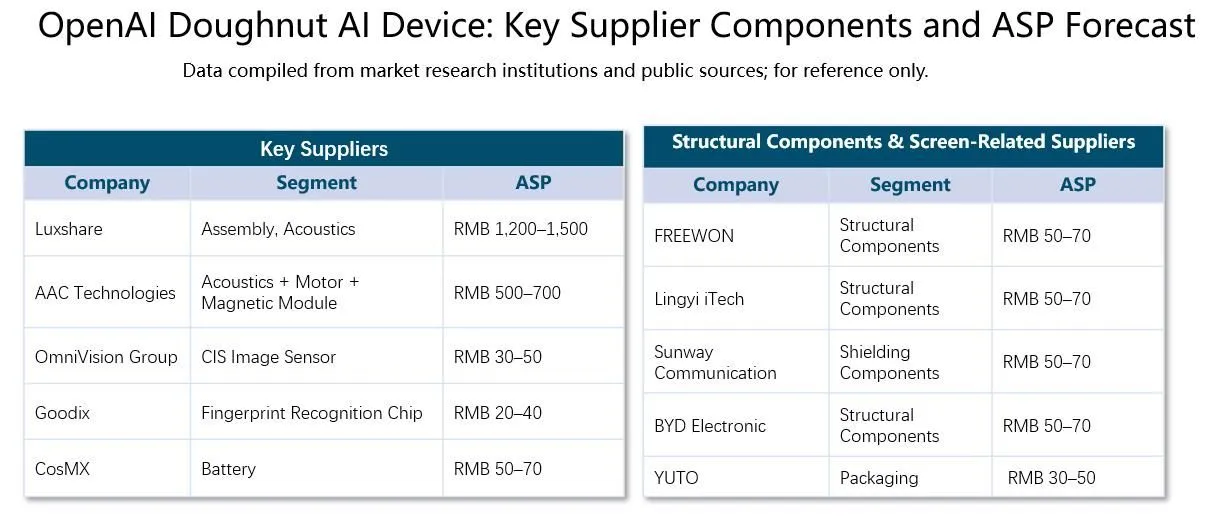
Hong Kong, Nov 2, 2026 - (ACN Newswire via SeaPRwire.com) - Recent reports about OpenAI's inaugural consumer AI hardware device have continued to gain traction. According to Bloomberg's Mark Gurman, this product—developed by OpenAI in collaboration with the team led by former Apple chief design officer Jony Ive— features a “doughnut-shape” and functions as a screenless AI speaker. This product is expected to launch in 2027 with a price tag of around $400 USD.OpenAI's foray into consumer hardware essentially represents a shift in the AI interaction gateway. While large language models have historically relied on web interfaces and mobile apps, the maturation of contextual dialogue capabilities has paved the way for screenless devices centered on pure voice interaction. These require no visual attention and are suitable for diverse scenarios, with the potential to become a long-term AI interaction hub.Recently, a market research institution comprehensively mapped OpenAI's edge-side supply chain investable listed-company targets, covering assembly, acoustics, motors, CIS, batteries, structural components, chips and shielding components. It also quantified each vendor's projected shipments, per-unit value, profitability and earnings elasticity. Under a base-case assumption of 10 million Doughnut units shipped, with an optimistic scenario of 50 million units under which profit elasticity is also modeled, value distribution varies significantly across segments.Changes in interaction paradigms have also raised the performance bar for hardware at the foundational level. Far-field voice pickup, real-time conversation, and high-fidelity audio output set extremely high standards, making the acoustic subsystem the core bottleneck for user experience and a key differentiator in hardware competition within this track.Within the entire supply chain, AAC Technologies (02018.HK) stands out as a scarce, high-value supplier, offering an integrated solution package of acoustics, motors, and magnetic modules. It enjoys a triple advantage of high per-unit value, high net margin and substantial volume elasticity. Its ASP reaches RMB 500–700, positioning its comprehensive profitability at the forefront of all core suppliers.The data shows Luxshare (02475.HK) with an ASP of RMB 1,200–1,500, though its business is primarily focused on device assembly with relatively lower net margins. OmniVision Group (00501.HK) supplies CIS image sensors at RMB 30–50 ASP; Goodix (603160.SH) provides fingerprint recognition chips at RMB 20–40 ASP—both with relatively higher net margins.Additionally, CosMX supplies batteries at RMB 50–70 ASP; Freewon, Lingyi iTech, Sunway Communication, and BYD Electronic supply structural components and shielding components, also at RMB 50–70 ASP.Industry sources indicate that the "doughnut" is merely OpenAI's first consumer hardware product, with AI earbuds, AI glasses, smart pens and other AI hardware terminals planned for the future roadmap. As the product matrix gradually materializes, core suppliers in the supply chain are well-positioned to secure orders and realize long-term growth.Source: Hong Kong Commercial DailyOriginal article: https://www.hkcd.com.hk/content_app/2026-10/28/content_8782248.html Copyright 2026 ACN Newswire via SeaPRwire.com. All rights reserved. www.acnnewswire.com
More
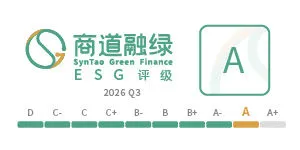
COSCO SHIPPING Ports Receives Two Accolades at the HKMA 2026 Best Annual Reports Awards, with SynTao Green Finance ESG Rating Simultaneously Upgraded to ‘A’ ACN Newswire

COSCO SHIPPING Ports Receives Two Accolades at the HKMA 2026 Best Annual Reports Awards, with SynTao Green Finance ESG Rating Simultaneously Upgraded to ‘A’

Hong Kong, Nov 2, 2026 - (ACN Newswire via SeaPRwire.com) - COSCO SHIPPING Ports Limited (“COSCO SHIPPING Ports” or “CSP” or the “Company”, SEHK: 1199), the world’s leading port logistics service provider, gladly announces that it recently received two prestigious awards, demonstrating the Company's outstanding performance and industry-leading position in investor relations and corporate governance, while its ESG performance continues to earn high acclaim from the market.Honored with Two Major Accolades at the HKMA 2026 Best Annual Reports AwardsOn 28 October, at the 2026 Best Annual Reports Awards presentation ceremony organized by The Hong Kong Management Association (HKMA), COSCO SHIPPING Ports was honored with the "Excellence Award for H-Share Companies & Red Chip Entries" and the "Best Environmental, Social and Governance Reporting Award (Shipping & Maritime)". The Awards aim to encourage the publication of timely, accurate, informative, and well-designed annual reports, and to recognize organizations demonstrating excellence in report preparation. In addition to complying with all relevant reporting standards, the Company’s annual report and ESG report received high acclaim from the judging panel for their outstanding understandability, clarity, and conciseness, as well as excellent illustration design and overall visual layout. Among this year’s award-winning enterprises, COSCO SHIPPING Ports shared the honor alongside a number of renowned local and international companies.(Photo: Ms. Venus Zhao, General Manager of Public Relations Division of COSCO SHIPPING Ports, attended the award presentation ceremony on behalf of the Company and accepted the two major accolades)The Hong Kong Management Association (HKMA) is a non-profit professional organization dedicated to promoting management excellence across Hong Kong and the wider region. By offering a diverse array of management education, training programs, and corporate exchange platforms, HKMA is committed to elevating management standards across the business community and various industries, standing as one of the most authoritative and influential associations in the local industry. The judging panel for this year’s awards comprises directors and senior executives from leading international and local companies, representing the market’s highest standards for annual report disclosures by listed companies.Professional Information Disclosure MechanismCOSCO SHIPPING Ports has established a multi-tiered, high-frequency investor communication mechanism. Through events such as results presentations, roadshows, investor days, and one-on-one meetings, the Company maintains close contact with domestic and overseas institutional investors and analysts. Adhering to strict transparency principles in information disclosure, the Company proactively publishes monthly throughput data and quarterly operating data to provide reference for investors' decision-making.Continues to Advance in ESG RatingsFurthermore, owing to its comprehensive performance across environmental, social, and corporate governance dimensions, the Company received an upgraded ESG rating of "A" from SynTao Green Finance, and was named in the "2026 Top 20 Hong Kong-listed Companies in the Industrial Sector for ESG Performance" list published by Sino-Securities Index. SynTao Green Finance is a professional service provider for in green finance and responsible investment in China. It continuously tracks the ESG performance of listed companies across A-shares, Hong Kong stocks, and US-listed Chinese equities, and is the only Chinese ESG rating agency adopted by Bloomberg, providing an important reference for investors evaluating corporate ESG performance. Meanwhile, the Sino-Securities ESG rating framework draws upon mainstream international methodologies and practices to evaluate the ESG performance of A-share and Hong Kong-listed issuers, showcasing companies' ESG performance through its industry rankings.(Photo caption: COSCO SHIPPING Ports ESG Rating Upgraded to ‘A’ by SynTao Green Finance)(Photo caption: COSCO SHIPPING Ports named in the "2026 Top 20 Hong Kong-listed Companies in the Industrial Sector for ESG Performance" list published by Sino-Securities Index)Looking AheadCOSCO SHIPPING Ports stated that the aforementioned awards and rating result reflect professional institutions' recognition of the Company's ongoing efforts to enhance information disclosure, ESG management, responsible operational practices, and disclosure quality. The Company will continue to integrate sustainability concepts into its corporate operations and management to drive high-quality and sustainable development. These accolades and rating upgrade serve not only as an affirmation of COSCO SHIPPING Ports' past achievements, but also as motivation to further deepen its sustainability and investor relations work. The Company consistently places sustainable development at the core of its long-term strategy. Guided by "The Ports for ALL" brand philosophy, the Company continues to advance green, low-carbon operations alongside efficient, transparent governance, constantly refining the quality of its investor relations practices and strengthening its ESG framework to effectively address the expectations and trust of all stakeholders. Moving forward, the Company will uphold higher standards in practicing ESG principles, continuously optimize its information disclosure system, and dedicate itself to becoming a leading global port logistics service provider-creating long-term, stable value for shareholders, customers, employees, and society.About COSCO SHIPPING Ports (https://ports.coscoshipping.com)COSCO SHIPPING Ports Limited (Stock Code: 1199) is a leading ports logistics service provider in the world and its terminals portfolio covers the five main port regions and the middle and lower reaches of the Yangtze River in China, Europe, the Mediterranean, the Middle East, Southeast Asia, South America and Africa, etc. As at 30 September 2026, COSCO SHIPPING Ports operated and managed 395 berths at 40 ports globally, of which 245 were for containers.Building on the brand philosophy of “The Ports for ALL”, COSCO SHIPPING Ports has established its corporate mission of “Connecting Different Worlds” and is committed to maintaining a customer-centric approach to continuously improve the service and capacity of its global network and enhance the strategic positioning of key node ports and optimise logistics resource distribution. Leveraging ports as a conduit to connect global shipping services and serve global trade, the Company is dedicated to establishing a platform for mutual benefits and shared successes for all stakeholders involved with a vision of becoming “the leading global port logistics service provider with a customer-oriented focus”. Copyright 2026 ACN Newswire via SeaPRwire.com. All rights reserved. www.acnnewswire.com
More
SAP Helps CHKP Group Connect Online and Offline Retail to Deliver Personalised Experiences at AV Life and FOTOMAX ACN Newswire

SAP Helps CHKP Group Connect Online and Offline Retail to Deliver Personalised Experiences at AV Life and FOTOMAX

Hong Kong, Nov 2, 2026 - (ACN Newswire via SeaPRwire.com) - As omnichannel retail and the experience economy grow, consumers increasingly expect personalised service. China-Hongkong Photo Products Holdings Limited (“CHKP Group”), whose businesses span audiovisual retail, photo printing, beauty & wellness, and commercial audiovisual systems integration, has implemented SAP Engagement Cloud across its two core retail brands: premium audiovisual chain AV Life and FOTOMAX, Hong Kong’s largest photo printing chain. By integrating online and offline customer data and interactions, the Group can tailor customer journeys to different segments, deliver personalised experiences and enhance business agility and growth potential.AV Life, which operates more than 10 stores across Hong Kong, uses SAP Engagement Cloud to help deliver a seamless shopping experience. After customers try products and receive expert advice in-store, sales staff can instantly generate electronic quotations with unique promotional codes. Customers receive the same offers whether they purchase in-store or online. The system automatically credits sales to the originating store and salesperson, giving customers greater purchasing flexibility while resolving online and offline channel conflicts. Automated follow-ups also significantly improve sales conversion rates.FOTOMAX operates more than 54 stores across Hong Kong, serving customers’ frequent, emotionally driven purchasing needs. SAP Engagement Cloud contributed to unifying online and offline interactions for approximately 330,000 members, creating a single customer view. The team can segment members by life stage and profile—including newlyweds, Gen Z consumers, travel enthusiasts and pet owners—and send timely reminders, such as photo album printing prompts for a baby’s 100-day celebration or graduation season. These relevant messages feel like thoughtful reminders rather than sales pitches, strengthening loyalty, encouraging repeat purchases and increasing average transaction value while maintaining a lean operations team. Automated reminders achieved an email open rate of 47%, compared with 42% for standard bulk emails, and a customer purchase rate of 14%, compared with 0.4%.“Digital transformation is not just about improving retail efficiency; it also enables business agility and strategic decision-making,” said Stanley Sun, Chief Executive Officer of China-Hongkong Photo Products Holdings Limited. “Our brands and teams previously worked towards different performance targets. SAP Engagement Cloud supported our efforts to break down these silos, enabling frontline marketing and back-office teams to collaborate around a shared customer view. Making customer experience a Group-wide capability helps us respond flexibly to a changing retail environment and build a solid foundation for sustained growth.”“Hong Kong’s diverse retail brands and extensive customer service expertise provide a strong foundation for continued innovation,” said Winnie Nieh, General Manager, SAP Hong Kong and Macau. “We are delighted to work with CHKP Group. SAP Engagement Cloud aims to connect online and offline customer interactions, helping AV Life and FOTOMAX deliver personalised experiences while improving cross-channel collaboration and operational efficiency. This partnership demonstrates how cloud technology can help organisations turn customer data into tangible business value. We look forward to deepening our collaboration with CHKP Group and working with more Hong Kong retailers to drive digital transformation and sustained growth.”About SAPAs a global leader in enterprise applications and business AI, SAP (NYSE:SAP) stands at the nexus of business and technology. For over 50 years, organizations have trusted SAP to bring out their best by uniting business-critical operations spanning finance, procurement, HR, supply chain, and customer experience. For more information, visit https://www.sap.com/hk ‚For media enquiries, please contact:Strategic Public Relations Group (SPRG):Andico Tsuiandico.tsui@sprg.com.hk+852 2114 4346 / 6902 3831 Copyright 2026 ACN Newswire via SeaPRwire.com. All rights reserved. www.acnnewswire.com
More
Vietnam’s E-Commerce Grew 44% in 2026. Its Parcel Count Grew 13.7%, and the Gap Is the Story ACN Newswire

Vietnam’s E-Commerce Grew 44% in 2026. Its Parcel Count Grew 13.7%, and the Gap Is the Story

HONG KONG, Nov 2, 2026 - (ACN Newswire via SeaPRwire.com) - In the first half of 2026, four platforms sold VND 291.6 trillion of goods in Vietnam. That is the number in the 2026 slide pack, usually rendered as 44.11% growth, usually followed by the sentence that the market has never been stronger. The same deck will tell you that in the first half of 2026 Shopee led with 54.5% and TikTok Shop closed at 43.4%, that official Mall stores are the only safe place to sell, and that the tax authorities have finally closed the loophole that let cross-border sellers undercut everyone.Each of those sentences is defensible on its own. Taken together they describe a market that is growing at more than twice the rate of the parcels moving through it, in which the two leaders hold 97.9% of the money and an unknown share of the sellers, and in which a compliance regime that began in February 2025 has had eighteen months to change behaviour. Whether it has is a question nobody in the deck answers, because the deck is selling the growth line and the growth line is doing the work.This piece takes the four claims one at a time. Where a number is solid, I say so. Where two official-looking numbers disagree, I put them side by side rather than picking the flattering one. Where the arithmetic does not reproduce a figure that everyone repeats, I show the division.The Claim, as It Appears in the DeckThe version I keep hearing in Hanoi and Ho Chi Minh City goes like this. Vietnamese e-commerce is the fastest-growing large market in Southeast Asia; it grew 44% in the first half of 2026 to VND 291.6 trillion, or about US$11.1 billion at the prevailing rate; Shopee and TikTok Shop together hold 97.9% of it; Mall stores, 2.79% of the store count, now take 34.2% of revenue; and the 2025 tax decrees have pushed the grey-market cross-border sellers out, which is why the growth is finally "healthy".The people saying this are not lying, and most of them have a source. The problem is that the sources measure different things, on different windows, with different denominators, and the composite sentence they produce is not something any single dataset supports.Start with the one figure that travels furthest: 44.11%. It appears in a presentation by the E-commerce Development Centre, a unit under the Ministry of Industry and Trade, reported in October 2026 with the accompanying shares of 54.5% and 43.4%. It is a revenue figure for four platforms, and it is real in the sense that someone computed it from platform data. What it is not is a like-for-like growth rate, and the reason is visible in a second number published five weeks earlier.Two Numbers for One Half-Year, 26.8 Trillion Dong ApartOn 12 August 2026, the Vietnam office of China's Ministry of Commerce relayed a report from Nguoi Lao Dong on the same six months. The figure there was VND 264.8 trillion, growth of 19%, down from 23% in the first half of 2025. Shopee 54.5%. TikTok Shop 43.4%.Same period. Same shares, to one decimal place. Two totals for the same six months of 2026 that differ by VND 26.8 trillion, and two growth rates that differ by 25 percentage points.Table 1: One half-year, two published totalsSourceH1 2026 GMV (VND trillion)Stated growthImplied H1 2025 base (VND trillion)YouNet ECI, via Nguoi Lao Dong, 12 Aug 2026264.8+19%222.5E-commerce Development Centre, Oct 2026291.6+44.11%202.4Difference26.825.1 points20.1The implied bases are the interesting part. Divide the August 2026 figure of 264.8 by 1.19 and you get 222.5. Divide the October 2026 figure of 291.6 by 1.4411 and you get 202.4. Neither base is obviously wrong, but they cannot both be the true 2025 half-year. One dataset has restated the base downward by VND 20.1 trillion, which is roughly what happens when a measurement house tightens its panel, drops a category it used to count, or switches from GMV booked at order creation to GMV net of cancellations and returns.That is not a scandal. It is what panel data does. But it means the sentence "the market grew 44%" and the sentence "growth slowed from 23% to 19%" are both being published in the same year about the same six months, and the second one is the one that matters for anyone deciding whether to hire a warehouse team in Binh Duong.My reading, and it is a reading rather than a finding: the 44.11% is a revenue-based growth rate off a restated base, and the 19% is a like-for-like growth rate off the original base. The shares agree because shares are computed inside each dataset and are robust to restatement. The growth rates do not agree because growth is exactly the thing a restatement moves.There is a test that would settle it, and it is cheap. Ask both houses for their 2024 and 2025 half-year totals on the current panel definition. If the 2025 base comes back near 202.4, the 44% is arithmetic and the 19% is a different panel. If it comes back near 222.5, the 44% is a base effect dressed as growth. Nobody in the deck has asked.Myth One: TikTok Shop Has Already Passed ShopeeThe most confidently repeated claim in the market is that TikTok Shop has overtaken Shopee in Vietnam. It has not, in any dataset I can find, and the claim survives because a rolling twelve-month window can be made to say almost anything.In October 2026, Metric published a twelve-month rolling series to April 2026 showing TikTok Shop at roughly US$5.96 billion and a 44% share, up from 33%, with Shopee down from 61% to 53%. That is a real finding: a ten-point swing in twelve months. Read quickly, it says the leader is about to be passed. Read carefully, it says the challenger gained ten points and is still nine behind.The half-year data says the same thing more soberly. In the first half of 2026 it was Shopee 54.5%, TikTok Shop 43.4%, a gap of 11.1 points. In the first half of 2025 the gap was wider. The direction is not in dispute. The crossing is.And the mechanism behind the narrowing has already weakened. TikTok Shop's revenue grew 27% in the first half of 2026, against 148% in the same period of 2025. When a challenger's growth falls by four-fifths while the leader grows 15%, the gap stops closing at the rate the rolling chart implies. Extrapolating a twelve-month swing into a crossing date is the single most common error in this market's commentary, and it is an error of arithmetic, not of judgement.Why the claim spreads is worth one paragraph, because it is not stupidity. Platform-share stories are how agencies sell services. "The incumbent is finished" is a better pitch than "the incumbent has 54.5% and is growing 15%", and the rolling window supplies a chart that looks like a crossing. The chart is honest. The sentence attached to it is not.Myth Two: Forty-Four Percent Growth Means Consumers Are Buying MoreHere the arithmetic is simple enough to do on a phone, and it changes the story completely.In the first half of 2026 revenue grew 44.11% while units sold grew 13.67%. Divide one by the other and the average order value rose 26.8%. In dong terms, the average basket went from about VND 371,000 to VND 470,000 if you take the E-commerce Development Centre's own totals and the reported unit growth, and NielsenIQ's separate measurement puts the basket at US$14.20, up US$1.80 year on year, which is 14.5% in dollar terms and consistent in direction.So the market did not sell 44% more things. It sold 13.7% more things at 26.8% higher prices. Those are different facts with different consequences.Table 2: What the growth is made ofComponentH1 2026 changeWhat it impliesPlatform revenue+44.11%The headlineUnits sold+13.67%Volume demandImplied average order value+26.8%Mix and price, not volumeActive stores with revenueabout 436,000A thinning seller baseStores excluding Mall-27% year on yearExit, not entryA 26.8% rise in basket size in six months is not a normal consumption pattern. It is what happens when the cheapest categories shrink, when subsidy-driven low-ticket orders stop being worth fulfilling, and when the platforms stop paying for growth. YouNet ECI's own analyst put it plainly in August 2026: the market is entering a stable phase that tracks overall retail rather than outgrowing it on platform incentives.That is a mature-market sentence. It is being printed underneath a 44% headline. Both are in the same report.For a seller, the difference is decisive. Volume growth of 13.7% supports a fulfilment and packaging business. Price-led growth of 26.8% supports brands, authorised distributors, and anyone who can defend a price. Vietnam's own data says the second group is winning: Mall stores are 2.79% of stores and 34.2% of revenue, their count fell 6% while their revenue rose 54%, and the average Mall store's revenue rose about 63.8%.Myth Three: The Small Seller Is the BackboneEvery market entry memo about Vietnam contains a version of this line: the market is fragmented, small sellers dominate, and a platform that serves them will inherit the growth. The store-count data points the other way.About 436,000 stores generated revenue on the major platforms in the first half of 2026. The number of ordinary, non-Mall stores fell 27% year on year in the first half of 2026. Mall stores fell 6% in count but rose 54% in revenue. Average revenue per store rose 44% on Shopee and 65% on TikTok Shop in the first six months of 2026.Put those together and you get a market where the seller base is contracting while revenue per surviving seller is rising. That is consolidation, and it is happening faster on the platform usually described as the small seller's friend. TikTok Shop's store-level average grew 65% because the stores that remained were better, not because the ones that left were replaced.The consequence is structural rather than moral. A platform whose growth comes from 436,000 surviving stores has less need for the long tail than one whose growth comes from store count. That shows up in take rates, in traffic allocation, and in how much a new seller has to spend on live-commerce production before the algorithm notices them. The long tail is not the customer any more. It is the inventory.The 25x That Nobody Can ReproduceHere is a small case of a number that has escaped its source.The claim, repeated in Chinese and Vietnamese trade coverage through 2026, is that a Mall store's average revenue is 25 times that of an ordinary store. The two inputs are solid: Mall stores are 2.79% of stores and 34.2% of revenue.Do the division. A Mall store's revenue index is 34.2 divided by 2.79, which is 12.3 times the all-store average. An ordinary store's index is 67.7 divided by 97.21, which is 0.696 times the average. The ratio between them is 17.6, not the 25 that 2026 trade coverage reports.Table 3: The Mall premium, recomputedMeasureMall storesOrdinary storesRatioShare of store count2.79%97.21%0.029Share of revenue34.2%67.7%0.505Revenue index vs all stores12.30.7017.6Seventeen-point-six times is still an enormous premium. It is not 25, and the gap between 17.6 and 25 is the difference between a fact and a slogan. If a plan assumes a Mall listing triples a seller's revenue relative to an ordinary listing, this arithmetic says it does something closer to eighteen times, which should make anyone suspicious of the plan rather than reassured by it. Numbers that flatter too much are usually measuring something else.Myth Four: The Tax Net Closes the DoorThe fourth claim is the one I have the most sympathy for, because the policy changes are real and they are recent.On 18 February 2025, Decision 01/2025/QD-TTg ended the VAT exemption for imported parcels valued at VND 1 million or less. Since February 2025 customs has run an automated collection mechanism against a flow of 4 to 5 million low-value orders a day. From 1 July 2025, Decree 117/2025/ND-CP required platforms with payment functions to withhold and remit tax on behalf of household and individual sellers. From 1 January 2026, the unified flat-rate regime was replaced: platforms with payment functions withhold VAT and personal income tax at source, platforms without a payment function leave the seller to declare, and sellers under VND 200 million in revenue can claim a refund of what was withheld. Decree 68/2026/ND-CP set the household-business threshold at VND 500 million of revenue, not profit.That is a genuine tightening. It is not a door closing, and the arithmetic of who it hurts is more specific than the commentary suggests.Table 4: The cost stack for a seller turning over VND 5 billion a yearLineBasisAnnual cost (VND million)Share of revenuePlatform commission at 7.5%Low end of published Q2 2026 rate cards375.07.5%Platform commission at 9.5%High end of the same cards475.09.5%VAT withheld on goods1% of revenue50.01.0%Personal income tax withheld0.5% of revenue25.00.5%Total platform and tax costCommission plus 1.5%450.0 to 550.09.0% to 11.0%Reported total operating cost30% of GMV, Momentum Works1,500.030.0%Read the last two rows together. In the 2026 schedule the tax that everyone is arguing about is 1.5% of revenue. The platform take in the Q2 2026 rate cards is 7.5% to 9.5%. Total seller operating cost, including fulfilment, returns, livestream production and ads, is around 30% of GMV in the 2026 Momentum Works estimate. The withholding decree moved the smallest line in the stack, and it moved it in a way that a seller can plan for, because it is a percentage rather than a negotiation.What the decrees actually changed is the floor. A seller who cannot absorb 1.5% was never covering 30%. A seller who can now has a cost line that is predictable, which is worth something to anyone trying to borrow against future cash flow. The grey-market operators who were arbitraging the VAT exemption on VND 200,000 items lost an edge worth about VND 20,000 a parcel. That is a real loss and a small one.The commentary that says the net "closes the door" also tends to get the rate wrong. One widely circulated advisory puts the platform withholding at 5% VAT plus personal income tax. The 5% rate is the services schedule. Goods distribution in Vietnam is 1% VAT plus 0.5% personal income tax, a combined 1.5%, which is what the decree applies to marketplace sales of physical goods. In 2026 a seller who budgets 5% will over-reserve by more than three times, and a seller who reads only the Chinese-language summaries will conclude the market has become uninvestable when it has become 1.5% more expensive.What the Withholding Actually ChangedThree things, and none of them is exit.First, it made revenue visible. Once the platform withholds at source, the seller's declared revenue and the platform's transaction record are the same number. That ends a specific kind of under-declaration, and it also ends the practice of using a partner's name to open a store while declaring only withdrawals.Second, it moved compliance cost onto the platform. Shopee's cost of services was US$9.5 billion in FY2025 and its sales and marketing expense US$3.55 billion. A withholding obligation is an engineering and reconciliation cost of a few million dollars, not a strategic threat to a company of that size. For a five-person seller, the same obligation is a monthly accounting task.Third, it made the small-seller exemption a cliff rather than a slope. The VND 500 million threshold under Decree 68/2026 is revenue, not profit, and a seller doing VND 40 million a month crosses it in month thirteen. There is no phase-in. That cliff, not the 1.5%, is the part of the policy that will change behaviour, because it punishes growth at a specific revenue point.What Survives the DebunkingFour claims, four different outcomes.The 44% is real as a published number and unreliable as a growth rate; the same six months also grew 19% depending on the panel. TikTok Shop has closed ten points and has not crossed; the crossing story depends on a rolling window and a growth rate that has already collapsed from 148% to 27%. The small seller is not the backbone; the seller base shrank 27% while revenue per survivor rose, and Mall stores at 2.79% of count take 34.2% of revenue. The tax net did tighten, by 1.5% of revenue on goods, not by the 5% that some advisories report, and its real effect is a cliff at VND 500 million rather than a wall at the border.What is left is a market that is consolidating, ageing into price-led growth, and becoming legible to the tax authority for the first time. That is a less exciting story than the one in the deck and a much more useful one, because each of those three adjectives implies a different investment.If you want one indicator to settle the whole argument, watch the gap between revenue growth and unit growth. In a healthy volume market the two converge. In the first half of 2026 they were 30.4 percentage points apart. If that gap narrows to single digits while revenue growth holds above 15%, the market is genuinely selling more to more people, and the 44% was a base effect. If revenue growth falls to 15% and the gap stays wide, Vietnam has imported the Korean pattern: a mature, brand-led, price-driven market where the platforms are utilities and the growth story is over. Both are fine outcomes. They require opposite plans.Data Basis: Six Numbers, Six DocumentsEvery figure above traces to a document, and the method is reproducible.· The H1 2026 platform total of VND 291.6 trillion and the 44.11% growth rate come from the E-commerce Development Centre presentation reported on 10 October 2026 in Hue, alongside the 54.5% and 43.4% shares.· The VND 264.8 trillion total and 19% growth rate come from YouNet ECI's H1 2026 report as relayed by Nguoi Lao Dong on 12 August 2026 and republished by the Vietnam office of China's Ministry of Commerce.· Unit growth of 13.67%, the 2.79% Mall store share, the 34.2% Mall revenue share, the 436,000 revenue-generating stores and the 27% decline in ordinary stores come from Metric's October 2026 release.· The VND 1 million VAT threshold, the 4 to 5 million daily low-value parcels, Decree 117/2025 and Decree 68/2026 come from Vietnamese customs and tax guidance as summarised by two trade advisories in 2026.· The 30% seller operating cost, the 89% to 85% platform share of total e-commerce and the US$9.5 billion Shopee cost of services come from Momentum Works' Southeast Asia report and Sea's FY2025 disclosure.· Basket size of US$14.20 and the 41.5% cash-on-delivery share come from NielsenIQ and State Bank of Vietnam data cited in the same trade reports.The two growth rates were not reconciled because the underlying panels were not published. I have said which one I think is like-for-like and why, and marked it as a reading rather than a finding. Anyone with access to both houses' 2024 and 2025 half-year totals can settle it in an afternoon, and until someone does, the honest version of the headline is a range: somewhere between 19% and 44%, with the shares agreeing and the growth disagreeing.Sources· YouNet ECI via Nguoi Lao Dong, republished by MOFCOM Vietnam 🔗 — Vietnam e-commerce growth slows in H1 2026, 12 August 2026· E-commerce Development Centre, Ministry of Industry and Trade, via Vietnam.vn 🔗 — Hue e-commerce conference reporting H1 2026 totals, 9 October 2026· Metric.vn data via 10100.com 🔗 — Vietnam platform shares and Mall store economics, October 2026· Momentum Works, Southeast Asia E-Commerce 2026 🔗 — regional GMV, platform shares and seller cost structure, April 2026· Vietnam Government, Decision 01/2025/QD-TTg as summarised by 10100.com 🔗 — end of the low-value import VAT exemption, February 2025· Vietnam tax and e-commerce decree summary, ASEAN trade briefing 🔗 — Decree 117/2025 and Decree 68/2026 withholding rules, July 2026· Bain, e-Conomy SEA 2026 🔗 — regional digital economy totals including Vietnam, October 2026 This article was prepared by the expert team at Global Infinity Labs, drawing on insights and data provided through its MCP data services. About Global Infinity LabsGlobal Infinity Labs is an AI innovation company specializing in MCP data services.Email: support@globalinfinitylabs.com Copyright 2026 ACN Newswire via SeaPRwire.com. All rights reserved. www.acnnewswire.com
More
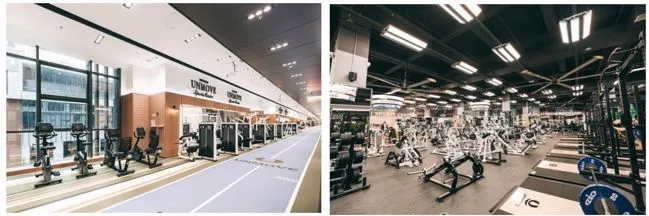
Global Buyers Praise Airwheel AI Wheel Boarding Carry on Smart 20 inch hand Luxury Cabin Suitcase at the 140th Canton Fair ACN Newswire

Global Buyers Praise Airwheel AI Wheel Boarding Carry on Smart 20 inch hand Luxury Cabin Suitcase at the 140th Canton Fair

Guangzhou, China, Nov 2, 2026 - (ACN Newswire via SeaPRwire.com) - The 140th China Import and Export Fair (Canton Fair) is now underway in Guangzhou, with Phase 3 entering its third day on November 2. As one of the world's major trade events, the exhibition brings together international buyers and businesses to explore new products, emerging technologies, and global trade opportunities.At this year's event, Airwheel is presenting its smart rideable suitcase portfolio and intelligent mobility innovations, attracting attention from international visitors. Through a combination of electric drive technology, intelligent controls, automated mechanical structures, and contemporary industrial design, Airwheel is demonstrating how traditional luggage can evolve into a more versatile travel companion.Beyond a Single Product: Building a Broader Smart Mobility EcosystemAirwheel's exhibition highlights a diversified portfolio designed for different travel needs, user groups, and mobility scenarios.The SE3S series, including the SE3SL+ Airport Boarding Suitcase, SE3SX Cabin Suitcase, and SE3SXD Ai Luxury Suitcase, represents the brand's continued development of smart rideable cabin luggage. Combining luggage storage with electric riding functionality, these models are designed to make movement through airports, exhibition venues, and other large spaces more convenient. Depending on the model, features include app connectivity, Apple Find My support, and intelligent lighting and control functions. Most models in this series offer a maximum riding speed of up to 9.9 km/h.For travelers who need greater storage capacity, the SE3T Ai Wheel offers a larger 24-inch format with approximately 48 liters of storage space. Its design extends Airwheel's smart mobility concept beyond conventional cabin luggage.Airwheel also develops products for younger users. The SQ3S Kids Suitcase, designed for children aged 5–8, combines luggage storage with rideable functionality and entertainment features, including a built-in speaker and Bluetooth audio connectivity. It reflects the brand's broader approach to developing intelligent travel products for different age groups and everyday scenarios.Together, these products demonstrate Airwheel's effort to move beyond a single smart suitcase concept and build a broader portfolio around intelligent travel and personal mobility.Automated Structures and Intelligent Controls Enhance the Riding ExperienceAmong the products on display, the SE3SXD Ai Suitcase showcases Airwheel's exploration of more advanced automation and integrated control technologies.Its automated mechanical design enables key components to extend and retract through coordinated operation. With one-touch activation, the front-wheel assembly and smart riding handle can automatically extend and lock into position, simplifying the transition between luggage and riding modes.Selected Airwheel models also support app-based controls, allowing users to access functions such as riding settings, lighting adjustments, and remote operations. Depending on the model, intelligent alerts can provide notifications related to battery status or connection range. Apple Find My integration on compatible models adds another layer of convenience when locating luggage.These features reflect Airwheel's continued investment in combining mechanical engineering, electric mobility, and connected technology to improve the overall travel experience.Engineering Details Designed Around Practical Travel NeedsBeyond intelligent functions, Airwheel places emphasis on product structure, materials, and everyday usability.Selected models feature a removable 73.26Wh modular lithium battery, providing flexibility for battery handling during transportation.The use of ABS and PC composite materials on selected models helps balance structural strength and portability. Airwheel also applies patented structural designs and integrated frame solutions to support product durability and riding stability.USB output is available on selected models, providing an additional charging option for compatible electronic devices while traveling.By integrating these practical details with electric drive and intelligent control systems, Airwheel aims to make smart luggage more adaptable to the needs of modern travelers.More Than 600 Global Patents and International Design RecognitionAirwheel's product development is supported by ongoing research into motion control algorithms, electric drive systems, intelligent sensing, and mechanical structures.The company has accumulated more than 600 global patents, reflecting its continued work in smart mobility technologies and product engineering.Its smart rideable suitcase portfolio has also received recognition from international design and innovation programs, including the WGA Wonder Global Design Award, iLuxury Awards, TITAN Innovation Awards, Asian Design Awards, French Design Awards, and MUSE Design Awards.These recognitions reflect Airwheel's ongoing efforts to combine practical functionality, technological innovation, and industrial design in products intended for international markets.Connecting Global Markets Through Intelligent MobilityAirwheel continues to expand its international presence, with products distributed across 68 countries and regions and supported by more than 4,600 retail terminals worldwide.The Canton Fair provides an opportunity for the brand to engage directly with international distributors, retailers, and business partners, exchange market insights, and explore new cooperation opportunities.Meet Airwheel at the 140th Canton FairPhase 3 of the 140th Canton Fair runs from October 31 to November 4, 2026. International buyers, distributors, retailers, and business partners are invited to visit Airwheel's exhibition spaces and experience its smart rideable suitcase portfolio firsthand.Exhibition Dates: October 31–November 4, 2026Exhibition Phase: Phase 3Booth Numbers: 20.2J37-38, 20.2K11-12, and 18.1K04Location: China Import and Export Fair Complex, Guangzhou, ChinaAirwheel welcomes visitors from around the world to explore its latest smart mobility innovations and discuss potential business cooperation.About AirwheelAirwheel is a smart mobility brand focused on intelligent electric mobility and smart luggage solutions for modern travel and everyday transportation. Its product portfolio includes smart rideable suitcases and personal mobility products that combine electric drive technology, intelligent controls, and contemporary industrial design.With continued investment in research and development, a growing international presence, and a portfolio of internationally recognized designs, Airwheel is exploring new ways to make everyday travel more intelligent, convenient, and connected.Media ContactCompany: AirwheelContact: Media TeamEmail: Jonas@airwheel.net Website: https://www.airwheel.net Copyright 2026 ACN Newswire via SeaPRwire.com. All rights reserved. www.acnnewswire.com
More
MicroVision Expands Collaboration with FieldAI Across Government and Industrial Autonomous Systems Programs ACN Newswire

MicroVision Expands Collaboration with FieldAI Across Government and Industrial Autonomous Systems Programs

Orlando, FL, Nov 2, 2026 - (ACN Newswire via SeaPRwire.com) - MicroVision, Inc. (NASDAQ: MVIS), a leader in advanced perception solutions for industrial, security and defense, and automotive applications, today announced an expanded collaboration with FieldAI, a developer of autonomous robotic systems for government and industrial applications.The collaboration builds on successful testing of MicroVision's perception technologies by FieldAI's Federal team, including evaluation of the IRIS™ long-range lidar sensor on autonomous ground vehicles and demonstrations of MicroVision's extended perception solution combining the Robinson Unmanned Spirit drone platform with the MOVIA™ Air Plus sensor for real-time, colorized 3D lidar mapping integrated with ATAK. In addition, FieldAI has purchased MicroVision MOVIA sensors for development and evaluation activities spanning both government and industrial autonomous robotics initiatives."FieldAI is pioneering autonomous systems designed for some of the most demanding operational environments, and we're excited to continue expanding our collaboration across both their Federal and Industrial organizations," said Glen DeVos, CEO of MicroVision. "From long-range perception for autonomous ground vehicles to real-time 3D mapping and short-range obstacle detection, our portfolio provides the flexibility and performance required to support next-generation robotic systems. We look forward to supporting FieldAI as they continue advancing autonomy across commercial and government applications.""The performance and versatility of MicroVision's sensing technologies have made them an important collaborator as we continue advancing autonomous capabilities across our platform portfolio," said Shehryar Khattak, Director of Technology at FieldAI. "Following successful tests across uncrewed ground and aerial systems, we are expanding our evaluation efforts to identify opportunities for broader adoption of MicroVision's perception solutions across both our Federal and Industrial programs."The collaboration reflects growing demand for advanced perception solutions capable of supporting autonomous mobility, navigation, mapping, obstacle detection, and mission execution across government and industrial robotic platforms. By combining MicroVision's portfolio of long-range, short-range, and aerial perception solutions with FieldAI's autonomy software and robotic systems expertise, the companies are exploring opportunities to accelerate deployment of next-generation autonomous capabilities in challenging operational environments.About Field AIFieldAI is the leader in deploying general-purpose robots in unstructured environments, providing frontier autonomy software as a universal "brain" that works across many robots and many tasks. The company's Field Foundation Models™ uniquely combine data-driven AI with physics-based reasoning and uncertainty awareness, enabling safe and reliable operations in environments previously considered too unpredictable for robots. FieldAI's leadership team brings together world-class expertise in AI foundation models and real-world robotics, with roots in Google DeepMind, NASA JPL's Mars exploration program, and DARPA's Subterranean Challenge and RACER programs. The company has raised over $400 million from investors including Bezos Expeditions, Emerson Collective, Khosla Ventures, Canaan Partners, NVentures (NVIDIA's venture capital arm), Prysm Capital, Temasek, and others. For more information, visitwww.fieldai.com or contact PR@fieldai.com.About MicroVisionMicroVision is defining the next generation of lidar-based perception solutions for industrial, security & defense, and automotive markets. As the industry moves beyond proof of concept toward value, deployment, and commercialization, MicroVision delivers integrated hardware and software solutions designed for real-world performance, automotive-grade reliability, and economic scalability. With engineering centers in the U.S. and Germany, MicroVision leads the industry in depth and breadth of its portfolio, with both short- and long-range lidar solutions, featuring solid-state sensors with varying wavelengths, advanced sensor architectures, design-to-cost engineering, and open software solutions.For more information, visit the company's website at www.microvision.com, on Facebook at www.facebook.com/microvisioninc, and LinkedIn at https://www.linkedin.com/company/microvision/. MicroVision, MicroVision HALO, IRIS, MOVIA, MOSAIK, and SENTINEL are trademarks of MicroVision, Inc., and SCANTINEL is a trademark of Scantinel GmbH, in the United States and other countries. All other trademarks are the property of their respective owners.Investor Relations Contact:Jeff ChristensenDarrow Associates Investor RelationsMVIS@darrowir.comMedia ContactHeidi Davidson - For MicroVisionheidi@galvanizeworldwide.com(914) 441-6862 Copyright 2026 ACN Newswire via SeaPRwire.com. All rights reserved. www.acnnewswire.com
More
Wintermar Offshore (WINS:JK) Reports Results for Third Quarter Ending 30 September 2026 ACN Newswire

Wintermar Offshore (WINS:JK) Reports Results for Third Quarter Ending 30 September 2026

JAKARTA, November 2, 2026 - (ACN Newswire via SeaPRwire.com) - Wintermar reports a 67.6%YOY jump in Operating Profit to US$24.7million for 9M2026 on 30.0%YOY revenue growth, supported by margin improvement from additional high-tier vessels in operation and better charter rates.Owned Vessel DivisionOwned Vessel revenue grew by 30.9%YOY to US$65.8million in 9M2026 with 2 units of additional DP vessels operational compared to 9M2025 while charter rates remained firm. Gross margin for Owned Vessels widened to 45.3% in 9M2026 compared to 40.0% in 9M2025 as there were more high tier vessels in operation this year. Fleet utilization remained stable at 60% in 9M2026 against 9M2025, although 3Q2026 utilization fell to 54% compared to 62% in 2Q2026, due to 3 high tier vessels completing long-term contracts. As a result of some delays in the tenders for long-term contracts, there are more vessels working on spot contracts which have resulted in short-term fluctuations in the utilization rate. The consolidation of Fast Offshore Supply Pte. Ltd. (FOS) for the first time in 3Q2026 offset some of there venue reduction from the core business. A few vessels are being prepared for deployment in 4Q2026, which has added to direct expenses but should improve utilization for the rest of the year.Chartering and Other Marine ServicesIn line with management strategy to prioritise owned vessels division and boost fee-based income, chartering revenue continued to decline 20.5%YOY to US$3.2million with gross profit of US$0.2million.Conversely, revenue from Other Marine Services rose by 68.2%YOY to US$6.9million for 9M2026, with gross profit from this division increasing by 42.8%YOY to US$2.0million.Direct Expenses and Gross ProfitDirect Expenses for Owned Vessels rose by 19.2%YOY to US$36.0million for 9M2026, largely from the consolidation of FOS vessels for the first time in 3Q2026 after the acquisition was completed end of 1H2026.Depreciation rose by 23.7%YOY to US$13.0million after including the FOS fleet in 3Q2026, as well as 2 additional Wintermar group vessels which began operation. Crewing costs rose by 25.2%YOY to US$10.2million, while fuel bunker costs increased by 46.8%YOY to US$2.6million from higher fuel prices and preparation for mobilization to long term contracts in 4Q2026. Operations expenses only increasing marginally by 4.4%YOY to US$3.6million and maintenance costs rose to US$6.6million from US$6.3million in 9M2025. Expenses from Other Marine Services rose 81.4% in line with the increase in income from the same division with more fee based services recorded.Total Gross Profit jumped by 46.7%YOY in 9M2026 to US$32.1million, with the Owned Vessel Division contributing US$29.8million.Indirect Expenses and Operating ProfitTotal Indirect Expenses increased by 3.3%YOY to US$7.4million in 9M2026, of which the largest expense, staff salary only increased by 1.4%YOY to US$5.0million. Traveling costs rose by 61.1% to US$0.1million driven by increase of ongoing operations outside Indonesia. Administrative expenses and professional fees increased by 14.4%YOY and 20.6%YOY respectively, mainly from costs associated with new bank loans and the acquisition of FOS. Office depreciation increased by 5.7% and office utility by 23.5%, mainly due to the addition of FOS's administrative and office assets following the acquisition.Operating Profit rose by 67.6%YOY to US$24.7million in 9M2026, reflecting a widening operating margin from 25.2% in 9M2025 to 32.5% in 9M2026.Other Income, Expenses and Net Attributable ProfitInterest expenses rose by 42.0%YOY to US$2.2million and interest income rose by 16.4%YOY to US$0.9million. The higher interest expenses reflect the Company's strategy of fleet expansion, which is financed by cash flow followed by refinancing through bank leverage once the vessels commence operation. At the end of 9M2026, WINS’ net gearing, after the consolidation of bank debt and cash from FOS, is 29%.Associated Companies recorded a loss of US$0.4million due to lower vessel utilization. A forex loss of US$0.5million was incurred in 9M2026 on the portion of the Company's cash held in Rupiah, due to Rupiah’s depreciation during the period.Net gain on sale of fixed assets fell by 4.2%YOY to US$1.6million due to lower vessel sale proceeds compared to last year, with one FOS vessel sold to a third party in 3Q2026. In addition, other income rose significantly to US$4.1million, mainly from the recovery of impaired receivables at FOS.Including the one-off gain, Total Attributable Net Profit rose by 91.9%YOY to US$17.7million compared to US$9.2million in 9M2025. Earnings per share rose to Rp70.5 in 9M2026 from Rp34.5 in 9M2025.EBITDA rose by 49.0%YOY to US$37.9million for 9M2026, compared to US$25.5million in 9M2025.Industry OutlookThe interim truce in the Iran conflict broke down in July with attacks on shipping in the Strait of Hormuz intensifying in October after the lack of progress on diplomatic resolution. The continued disruption highlights the risks of relying on Middle Eastern oil supply. With Brent crude averaging over US$114 per barrel in September, global oil and gas investment has been steadily rising. Westwood Research has forecasted offshore field development capital expenditure to jump by 30%YOY in 2026.In Indonesia, the Government continues to push exploration in 2026 with the 5 Strategic National Projects (PSN) worth US$48.1billion that have all reached key milestones.As these projects move into the construction and installation stage from 2027, there will be a concurrent demand for high-tier Offshore Support Vessels to support these domestic projects. Wintermar has been positioning our fleet to benefit.Globally, the OSV fleet remains tight. Westwood expects OSV utilization to rise above 79% in 2027, while more than half of the operational fleet is now over 15 years old. With very limited newbuilding since 2015, vessel supply is expected to remain tight in the coming years, particularly for dynamic positioning-enabled PSVs, pointing to higher charter rates.Business StrategyAs detailed in our previous newsletter, Wintermar’s strategy has been to grow the core business through purchasing secondhand vessels while ordering newly built vessels to renew and upgrade the high value fleet. The acquisition of FOS in June 2026 has added significant visibility of earnings to the Group as a result of the 5 year newbuild CTV charter contracts in 2027 and shipbuilding deliveries in 2028.Our fleet renewal plan for the core business is now well underway. The 8th PSV that was purchased last year will start operations in November. In July 2026, we purchased 2 second-hand diesel-electric (DE) vessels, of which one unit of DE Anchor Handling Tug Supply (AHTS) commenced operations in September, while the other vessel, a Multi Role Support Vessel (MSV), will be operationally ready in 1H2027. In addition, under our newbuild strategy, one PSV and two MSVs are expected to be delivered in 2H2027.Through FOS, we have acquired 6 units of existing FMPVs, of which 2 have long-term contracts. FOS is currently building the first 5 units of brand new CTVs, which have been contracted for 5 years with options and will be operational starting from 1Q2027, with the first unit already in the sea trial stage. In addition, FOS will deliver another 5 CTVs to a client in 1H2028 through its shipbuilding business.2026 has been a year of investing in future growth through capital expenditure, leveraging on the balance sheet to improve our fleet composition with focus on high value vessels. As the shipbuilding at FOS progresses, net gearing will continue to rise before the vessels are completed and commence operations in 2027.Total contracts on hand as at end September 2026, including FOS, amounted to US$200million, of which around 75% are international contracts.Ms. Pek Swan Layanto, CFAInvestor RelationsPT Wintermar Offshore Marine TbkTel (62-21) 530 5201 Ext 401 Email: investor_relations@wintermar.com DISCLAIMERCertain statements made in this publication involve a number of risks and uncertainties that could cause actual results to differ materially from those projected. Certain statements relating to business and operations of PT Wintermar Offshore Marine Tbk and Subsidiaries (the Company) are based on management’s expectations, estimates and projections. These statements are not guarantees of future performance and involve risks, uncertainties and assumptions that are difficult to predict. Certain statements are based upon assumptions as to future events that may not prove to be accurate. Therefore, actual outcomes and results may differ materially from what is expressed or forecasted in such statements. The Company makes no commitment, and disclaims any duty, to update or revise any of these statements. This publication is for informational purposes only and is not intended as a solicitation or offering of securities in any jurisdiction. The information contained in this publication is not intended to qualify, supplement or amend information disclosed under corporate and securities legislation of any jurisdiction applicable to the Company and should not be relied upon for the purpose of making investment decisions concerning any securities of the Company. Copyright 2026 ACN Newswire via SeaPRwire.com. All rights reserved. www.acnnewswire.com
More
Indonesia Says It Has Too Much Rice. Three Official Numbers Say Otherwise ACN Newswire

Indonesia Says It Has Too Much Rice. Three Official Numbers Say Otherwise

HONG KONG, Nov 1, 2026 - (ACN Newswire via SeaPRwire.com) - On 30 September 2026, workers at a Bulog warehouse in Balikpapan, East Kalimantan, were photographed checking rice stocks. The picture ran with a story that has become routine in Jakarta this year: state procurement had passed 4.11 million tonnes of farmers' rice, beating the 4 million tonne target for the whole of 2026 with three months to spare, and the national reserve had touched about 5.4 million tonnes, the highest since independence.The same week, the government said something larger. Indonesia had reached rice self-sufficiency, the 2026 import order was cancelled, a programme to clear forest for new rice fields was being wound down, and officials were exploring premium rice exports to Malaysia. The reserve, readers were told, covers demand into the first quarter of 2027.All of that may be true. The problem is narrower and more awkward. The four numbers doing the work in those two paragraphs, production, self-sufficiency, reserve and consumption, come from different agencies, use different denominators, and in at least one case cannot all be true at the same time. This piece takes them one at a time and checks whether they add up. Where they do not, the gap is not a scandal. It is a measurement problem that the policy has already spent money against.The Claim, Quoted PreciselyHasil Sembiring, special adviser to the agriculture minister for production enhancement, put the case on the record at a Jakarta briefing on 10 August 2026. Output had risen, reserves were stronger, incentives had improved, and the country was on a path to a more productive and self-sufficient food system.The numbers behind that sentence, as published by the statistics agency and relayed by state media, are these. Paddy output reached 34.69 million tonnes in 2025, against 30.62 million tonnes in 2024, a gain of 13.29%. Harvested area rose to 11.32 million hectares from 10.05 million. The food self-sufficiency ratio moved from 87.14% in 2024 to 110.25% in 2025.Those are not forecasts. They are presented as measured outcomes. Two of them, the production total and the ratio, are the load-bearing claims for everything that follows: the cancelled import, the export trial, the wind-down of land clearing.The 13.29% Is a Land Story, Not a Yield StoryStart with the easiest check, because it is pure division.Divide 34.69 million tonnes by 11.32 million hectares and output per hectare comes to 3.06 tonnes. Do the same for 2024: 30.62 divided by 10.05 gives 3.05 tonnes. The difference is under one percent.Harvested area, meanwhile, rose 12.6% in a single year. That is a very large movement in a country where new paddy land is scarce and where the government has been trying to stop converting forest into fields. It is possible. It is also the kind of number that usually comes from a change in how area is counted rather than from 1.27 million new hectares appearing between two harvests.The library decomposition used for this piece puts 94.8% of the 2025 output gain on area and 5.2% on yield. The published totals support that split. They do not support a story about farmers getting more rice from the same ground, which is the version usually told, because yield did not move.This matters for the policy, not just for the ledger. Area-led growth has a hard ceiling and a political cost, since the cheapest remaining land is forest. Yield-led growth does not. If the 13.29% came from area, then the 2026 target inherits a problem: the same trick cannot be run twice without more land, and the land programme is being closed.Three Forecasts for One Harvest, 23.3% ApartThe 2026 numbers get worse before they get better. Three published forecasts exist for the same crop year, and they do not describe the same country.Table 1: What three published sources project for Indonesia's 2026 paddy cropSource2026 paddy output (million tonnes)Stated basisBapanas, via ANTARA31.3Food agency projectionAsia Daily, citing agency data34.77Reported projectionANTARA, 2026-2027 outlook38.6Reported projectionSource: ANTARA 🔗, August 2026; agency projections as reported.The gap between the low and high figure is 23.3%. On a base of roughly 35 million tonnes that is about 7.3 million tonnes, or more than the entire national reserve at its record peak. A country that cannot say within 7 million tonnes how much rice it will grow this year is not in a position to cancel imports on the strength of the forecast.The low end deserves particular attention because of who produced it. A 31.3 million tonne crop would be below the 2025 outturn of 34.69 million, which means the food agency's own projection implies a 9.8% decline in the year the government declared self-sufficiency and stopped importing. Either the projection is conservative, or the declaration rests on a crop the agency does not expect.The high end, 38.6 million tonnes, would be a 11.3% increase on 2025 and would require another area jump on top of the one that just happened. Nothing in the procurement data suggests that is under way: Bulog's 4.11 million tonnes bought from farmers is strong, but it is a purchase number, not a production number, and it can rise while output falls if farmers choose to sell to the state instead of to traders.The Ratio That Cannot HoldNow the self-sufficiency ratio, which is the number most quoted and the least examined.The series runs 91.04% to 98.88% across 2020 to 2023, drops to 87.14% in 2024, then leaps to 110.25% in 2025. A 23.1 point move in twelve months.A ratio of production to consumption is only as good as its denominator, and the denominator here is not published with the ratio. But it can be recovered by division. At 110.25%, a 34.69 million tonne crop implies national consumption of 31.47 million tonnes. At 87.14%, a 30.62 million tonne crop implies consumption of 35.14 million tonnes.Put those two implied figures side by side and the problem appears. Consumption would have fallen 10.4% in one year, from 35.14 to 31.47 million tonnes, in a country whose population grew, whose free meal programme expanded to 83 million beneficiaries, and whose government was simultaneously worried about feeding people.A 10.4% drop in rice consumption in a single year has no plausible mechanism. Households do not halve their rice. The free nutritious meals programme, budgeted at IDR 335 trillion for 2026 and covering 83 million people, adds demand rather than removing it, at roughly IDR 304 per person per day on the programme's own arithmetic.So one of the two ratios is wrong, or the two are computed on different bases. Since both are attributed to the same agency and the same methodology family, the likeliest explanation is a denominator that changed definition between years, most probably a shift between "production available for food" and gross paddy output, or a change in the conversion rate from paddy to milled rice.There is a third witness. The government's own working figure for national rice consumption is 2.5 million tonnes a month, which is 30 million tonnes a year. Against 34.69 million tonnes of paddy that is a ratio of about 115.6%, not 110.25%. Against 31.3 million tonnes of forecast 2026 output it is 104.3%, and against a milled-rice conversion, which is how consumption is actually measured, it falls below 100%.Three official anchors, 110.25%, 115.6% and 104.3%, none of which is the number in the press release.Reserves, and the Difference Between a Stock and a BufferThe reserve numbers are the strongest part of the government's case, and they are internally consistent in a way the ratios are not.Table 2: Government rice reserve by release date, with the stated target for comparisonDateGovernment reserve (million tonnes)Note2025 target4.0Annual target2025-12-313.248Year-end stock2026-01-073.25Start of year2026-06-185.2Post-harvest build2026-07-305.25Record at the time2026-10-095.4Peak since independenceSource: Shangbao Indonesia 🔗, 9 October 2026; earlier figures from state media as compiled.The build from 3.25 to 5.4 million tonnes in nine months is real, and it was bought at IDR 6,500 per kilogram, a floor price that protects farmers and costs the budget money on every tonne. The 2026 food security budget is IDR 210.4 trillion, up from IDR 139.4 trillion in 2025.Here is the catch. A 5.4 million tonne reserve against 2.5 million tonnes of monthly consumption is 2.2 months of cover, not the "into the first quarter of 2027" that the coverage language implies. To reach the first quarter of 2027 from October 2026 requires about five months. The national figure that does reach five months, 12.53 million tonnes total stock on 7 January 2026, includes household and trader inventories, which the government does not control and cannot release.Government reserve coverage at that January date, on the same arithmetic, was 1.3 months. That is the number that governs what happens in a bad year. It has improved since, to roughly 2.2 months, and it is still not five.Self-Sufficiency in One Commodity, Imports in the RestThe word in the announcement is food, but the number behind it is rice. That distinction is where the policy gets expensive.Indonesia tracks 11 strategic food commodities. Eight of them are reported as running a production surplus in 2026. Rice is one. The three that are not are the ones that show up in the import bill every year, and they are not small: soybean imports are projected at 26.4 million tonnes for 2026, garlic at 679,895 tonnes, beef at 321,660 tonnes. Those are forecasts, and they should be read as forecasts, but the direction has been stable for a decade.Soybean is the awkward one, because it is not a luxury. Tempeh and tofu are the cheapest protein in the country and they are made from imported beans. A rice surplus of 3 million tonnes and a soybean deficit of 26 million tonnes are not the same kind of achievement, and no ratio that averages them is useful.The free nutritious meals programme sharpens the point. Budgeted at IDR 335 trillion for 2026 and reaching 83 million people, it is the largest demand-side intervention in Indonesian food since the 1998 crisis. Its per capita allocation works out to about IDR 304 a day, which buys roughly a fifth of a kilogram of rice at the procurement floor price, or a portion of eggs, or a small piece of fish. The programme's kitchen-level sourcing decisions, not the paddy harvest, will determine whether it lifts protein consumption or simply adds volume to the rice channel.There is also a labour question hidden in the area story. If 1.27 million additional hectares were harvested in 2025, someone planted and cut them. Indonesian agriculture has been losing workers to manufacturing and services for a decade, and the harvest labour market is already tight in the main producing provinces during the peak season. An area-led expansion is therefore not just a land constraint. It is a labour constraint that shows up as a wage bill two seasons later.None of this is an argument against the reserve. Buying 4.11 million tonnes at IDR 6,500 protects farmers from the price collapse that a big harvest normally brings, and that is a legitimate use of a state buyer. The argument is about which number gets used to justify the next decision. A rice surplus is not food security. It is a rice surplus, in one commodity, in one year, produced mostly by putting more land under the crop.Where the Numbers Cannot CoexistThree specific incompatibilities, stated as plainly as possible.First, a 2025 self-sufficiency ratio of 110.25% and a 2026 production forecast of 31.3 million tonnes cannot both be right unless consumption collapses by a further 9% in 2026. The ratio says the country has a surplus. The forecast says next year's crop is smaller than this year's consumption.Second, the decision to cancel the 2026 rice import sits on top of that forecast, not on top of the 2025 outturn. Imports are bought against the coming year. If the food agency's own projection is 31.3 million tonnes and consumption is 31.47 million tonnes at the 110.25% denominator, there is no surplus to export and very little to hold.Third, the export initiative to Malaysia has no volume behind it that survives the reserve math. Every tonne exported comes out of a 5.4 million tonne stock that represents 2.2 months of cover. A country with 2.2 months of buffer does not have exportable surplus, whatever its ratio says.None of this means Indonesia is short of rice today. Bulog bought 4.11 million tonnes, the reserve is at a record, prices were defended at the farm gate, and the harvest was large. It means the four numbers used to describe that success are drawn from four different frames, and the frame that gets quoted, the ratio, is the one that moves the most and is explained the least.The Fraud Cases That Make the Optimism ExpensiveThere is a reason to be strict about agricultural statistics in Indonesia that goes beyond bookkeeping, and it is sitting in the court records.eFishery, once valued at USD 1.4 billion, collapsed after revenue irregularities surfaced at the end of 2024. Its founder was sentenced to nine years in April 2026; prosecutors had sought ten. Cumulative funding was about USD 415 million across four rounds, and investor losses are put at roughly USD 300 million. A fine of IDR 1 billion was imposed, a sum that rounds to nothing against the losses.TaniHub is the second case, and the more instructive one. Six defendants were sentenced in June 2026: the founder to nine years, the finance director to seven, a former MDI Ventures chief executive to five, and a former BRI Ventures chief executive to three. State losses were assessed at USD 25 million, against USD 20 million from MDI and USD 5 million from BRI Ventures. The company had been valued at USD 218 million in May 2021. Its lending arm reached a non-performing loan ratio of 63.9% in 2023, was restricted by the regulator in April 2023, and lost its licence in May 2024. Bad loans of IDR 693 billion, operating losses of IDR 437 billion, and overstated earnings of IDR 359 billion are all in the file.The pattern is the one that matters for statistics: a lending book, a valuation and a growth story that all depended on numbers nobody outside the company could check. Agricultural data in Indonesia is harder to falsify than a fintech loan book, because the statistics agency does sample surveys. But the same reflex, treating an unverified number as a settled one because the policy needs it, is what produced a 23 point jump in a ratio that no one has published a denominator for.What Would Prove This WrongThe argument here is that the 110.25% ratio is a measurement artefact, that the 2026 crop is smaller than the 2025 crop, and that the reserve is thinner than the coverage language suggests. Four observations would settle it against me.If the statistics agency publishes, before the end of 2026, a methodology note that fixes the consumption denominator and shows both years on the same basis, with 2024 also above 100%, then the jump is a revision and not an artefact. Watch for a restated 2024 figure.If Bulog's procurement for the full 2026 season exceeds 5 million tonnes without a further price increase above IDR 6,500, then the crop is genuinely larger than the low forecast and the area expansion was real.If the government publishes monthly rice stock including household and trader inventories for two consecutive quarters and the government share of that total rises above 45%, the reserve is deeper than 2.2 months of cover implies.And if an actual export contract to Malaysia is signed and shipped, with a volume and a date, then there is exportable surplus and this piece is wrong about the arithmetic. Not the announcement of intent. The bill of lading.MethodologyData as of October 2026. Three denominators are in play and they are not interchangeable. The self-sufficiency ratio is treated here as production divided by consumption; the consumption figure is never published, so it is recovered by dividing published output by the published ratio, which is exact arithmetic on two stated numbers and inherits any rounding in the ratio. Per hectare output divides paddy output by harvested area, both from the statistics agency as relayed by state media, and is a gross paddy measure, not milled rice. The paddy to milled conversion is not applied anywhere in this piece, because the conversion rate is not stated in the sources; where a milled comparison would change a conclusion, the text says so. Reserve coverage divides the government-held stock by the stated monthly consumption of 2.5 million tonnes, and excludes household and trader inventories, which is why it differs from the national stock coverage figure. The 94.8% / 5.2% decomposition is a library calculation from the area and output totals, and the direct per hectare arithmetic is shown so a reader can check it independently. Cost figures are nominal rupiah, not inflation adjusted.LimitationsThe three 2026 forecasts are attributed to different intermediaries and may not share a cut-off date, so part of the 23.3% spread could be timing. The consumption denominator is inferred, not published, which means the 10.4% implied drop is a property of the ratios rather than a measured fact. And the reserve series mixes target, year-end and intra-year figures from different releases, so the month-to-month path is indicative.Sources· ANTARA 🔗, Indonesia confident on food security outlook as farm output rises, 10 August 2026· Shangbao Indonesia 🔗, Bulog procures 4.11 million tonnes, reserve peak 5.4 million, 9 October 2026· CNA 🔗, TaniHub case verdict and investor losses, June 2026· The Straits Times 🔗, eFishery founder sentenced to nine years, April 2026· Agency production and area statistics for 2024 and 2025 as relayed by ANTARA, no public dataset link (no public link) This article was prepared by the expert team at Global Infinity Labs, drawing on insights and data provided through its MCP data services. About Global Infinity LabsGlobal Infinity Labs is an AI innovation company specializing in MCP data services.Email: support@globalinfinitylabs.com Copyright 2026 ACN Newswire via SeaPRwire.com. All rights reserved. www.acnnewswire.com
More
A Better Life Through Ai Wheel Mobility Scooter 20 inch Boarding Luggage: Airwheel Smart Carry on hand Luxury Cabin Suitcase Shine at the 140th Canton Fair ACN Newswire

A Better Life Through Ai Wheel Mobility Scooter 20 inch Boarding Luggage: Airwheel Smart Carry on hand Luxury Cabin Suitcase Shine at the 140th Canton Fair

Guangzhou, Oct 31, 2026 - (ACN Newswire via SeaPRwire.com) - The third phase of the 140th China Import and Export Fair (Canton Fair) officially opened on October 31, bringing together global buyers seeking innovative products for modern lifestyles and travel. Airwheel, a smart mobility brand, is showcasing its range of rideable electric luxury suitcase, attracting attention from international buyers with products that combine electric mobility, intelligent features, and practical luggage storage.By integrating electric riding capabilities into the familiar cabin suitcase format, Airwheel is exploring new ways to make everyday travel more convenient, flexible, and enjoyable.Strong Interest from International Buyers on Opening DayFrom the opening hours of the exhibition, Airwheel's booth welcomed a steady stream of international buyers. Drawn by the distinctive concept of a suitcase that can also be ridden, visitors stopped to explore the products, ask questions, and experience the riding functions firsthand. Some buyers also expressed purchasing interest during on-site discussions.Throughout the exhibition area, visitors could be seen trying Airwheel's electric suitcases, experiencing a different approach to moving through large exhibition halls. The combination of riding and conventional luggage functions offers an alternative to traditional suitcases that rely entirely on pulling or pushing, making Airwheel a notable attraction in the luggage and travel products section.Beyond its distinctive appearance, Airwheel's smart electric cabin suitcase is designed around practical travel needs. It retains the essential storage function of conventional luggage while incorporating an electric riding system. In suitable environments, users can ride the suitcase to reduce the effort associated with long walks through airport terminals, large exhibition centers, and other spacious venues. When riding is unnecessary or unsuitable, the suitcase can be used in conventional push-and-pull mode, allowing users to adapt to changing surroundings.Selected models also feature app-based controls, location-related functions, and ambient lighting, bringing connected technology into the travel experience. The 20inch cabin-size design enables convenient carry-on travel. Its 73.26Wh removable lithium battery has passed multiple international certifications and meets aviation boarding standards.One Smart Suitcase, Multiple Everyday ApplicationsAirwheel's rideable suitcase concept extends beyond the airport. By combining luggage storage with electric mobility, the products are designed to support different travel scenarios, from business trips and shopping excursions to everyday journeys.Airport Mobility, ReinventedLong airport corridors, transfers between terminals, and walks to distant boarding gates can make air travel physically demanding. Airwheel's riding and conventional rolling modes give users greater flexibility when moving through appropriate areas.The 20-inch cabin-size format creates a practical airport boarding suitcase for air travellers.Business Travel Without LimitsFor professionals attending international exhibitions, conferences, and business meetings, moving efficiently between destinations is an important part of the travel experience. From airports and hotels to convention centers and exhibition halls, Airwheel's electric suitcase provides an alternative way to move while carrying clothing, business documents, laptops, and other travel essentials.At the Canton Fair, visitors can experience the products directly in a large exhibition environment, gaining a clearer understanding of how rideable luggage may fit into business travel routines.Smarter Shopping and Leisure MobilityLarge shopping malls, commercial complexes, and suitable open spaces offer other potential applications for rideable luggage. Users can carry personal belongings and shopping items in the suitcase while choosing between riding and conventional rolling according to the distance, surroundings, and their own preferences.When entering crowded areas or spaces where riding is not permitted, users can switch to conventional luggage handling. This flexibility extends the potential use of smart rideable suitcases beyond airports and railway stations to shopping, leisure, and urban exploration.Effortless Everyday TravelInnovation does not have to mean abandoning familiar habits. Airwheel's smart suitcases retain the basic storage functionality of conventional luggage, with a telescopic handle and rolling wheels for everyday handling when electric riding is not needed.Depending on the model, users can also access features such as app-based controls, location-related functions, and lighting options. By combining familiar luggage operation with additional mobility capabilities, Airwheel aims to make intelligent technology a practical part of everyday travel.Technology Designed Around Better Travel ExperiencesInterest at the Airwheel booth reflects growing curiosity about products that combine conventional travel essentials with new mobility capabilities. For travelers who regularly navigate large airports, exhibition venues, and other expansive environments, the value of a smart suitcase lies not only in its appearance but also in how it can address everyday travel challenges.Airwheel's approach focuses on making luggage more adaptable to different journeys: reducing the physical effort associated with long-distance movement, maintaining practical storage capacity, and offering users greater flexibility in how they move.This philosophy aligns naturally with the third phase of the Canton Fair and its emphasis on products that contribute to a better quality of life. A more enjoyable journey is not simply about reaching a destination; it is also about making the experience along the way more comfortable and convenient.By bringing electric drive systems and intelligent features into a familiar travel product, Airwheel continues to explore how smart mobility technology can improve the way people travel.A Broader Smart Rideable Suitcase Portfolio for Global MarketsAt the third phase of the 140th Canton Fair, Airwheel is presenting a broad portfolio of smart rideable suitcases designed for different users and travel scenarios.The lineup includes the SE3S series of 20-inch smart rideable cabin suitcase, the 24-inch SE3T electric rideable checked Ai wheel suitcase, and the SQ3/SQ3S children's rideable Kids suitcase. Together, these products address a range of needs, from everyday mobility and airport travel to longer trips and family outings.Supported by a portfolio of more than 600 global patents, Airwheel continues to develop technologies in electric drive systems, motion control, and intelligent sensing. Its products have also received recognition from international design and innovation programs, including the MUSE Design Awards, French design awards, Asian Design Awards, and iLuxury Awards.The strong interest at the exhibition provides opportunities for Airwheel to engage with international buyers, exchange market insights, and explore potential business partnerships.Meet Airwheel at the 140th Canton FairAs Airwheel continues to develop products for different users and travel scenarios, its focus remains on combining practical design with intelligent mobility technology. From airport terminals and business exhibitions to shopping trips and leisure travel, the brand aims to make luggage a more versatile companion for exploring the world.Airwheel invites international buyers, distributors, and business partners to visit its booths during the third phase of the 140th Canton Fair to experience its smart rideable suitcase portfolio firsthand and discuss potential cooperation opportunities.Exhibition: The 140th China Import and Export Fair (Canton Fair), Phase 3Dates: October 31–November 4, 2026Airwheel Booths: 20.2J37-38, 20.2K11-12, and 18.1K04Airwheel is committed to making every journey more convenient through intelligent mobility innovation — bringing greater freedom and flexibility to everyday travel.Media ContactCompany: AirwheelContact: Media TeamEmail: Jonas@airwheel.net Website: https://www.airwheel.net Copyright 2026 ACN Newswire via SeaPRwire.com. All rights reserved. www.acnnewswire.com
More

Malaysia Repriced 5G Twice. The Bill Lands on Two Balance Sheets ACN Newswire

Malaysia Repriced 5G Twice. The Bill Lands on Two Balance Sheets

HONG KONG, Oct 31, 2026 - (ACN Newswire via SeaPRwire.com) - On paper, Malaysia finished its 5G argument. Two wholesale networks now run side by side, a state-owned wholesaler sells capacity to three tenants, and a fourth operator built its own. Subscriptions passed 30 million, adoption passed 88%, and the regulator spent 2026 rewriting the access rules to keep the two networks from strangling each other. Every milestone the policy promised has been met.In practice, the people who paid for those milestones have not finished paying. CelcomDigi and Maxis, the two listed operators still buying wholesale capacity from Digital Nasional Berhad, are about to consolidate that wholesaler onto their own books as a 33% associate in the fourth quarter of 2026. They are doing so after watching its two largest customers leave. Telekom Malaysia served notice on 24 February 2026 and signed a three-year wholesale deal with U Mobile instead. U Mobile migrated every customer off DNB on 1 July 2026 and now runs its own network.The judgment this article defends is narrow enough to be falsified: Malaysia's mobile cost per gigabyte is falling for reasons that have nothing to do with retail competition, and the savings will be competed away before shareholders see them, because the two variables doing the work are both cost-side and neither one creates pricing power. If wholesale revenue per gigabyte stops falling in 2027, that judgment is wrong.Two Cost Curves Moved at Once, and Only One Was ScheduledThe first variable is integration. CelcomDigi's merger, closed in 2022, has been converting two networks into one on a timetable that keeps slipping at the edges. Network integration passed 90% by May 2026. The IT layer, the billing and customer relationship systems that decide whether a merged company behaves like one company, was 85% done in February 2026 and is now scheduled to finish in the second half of 2027.The money is real and already showing. CelcomDigi booked RM40 million of savings in the first quarter of 2026 and RM141 million across the first half, then raised its full-year cost target to RM470 million from RM450 million. Management still guides to RM700 million to RM800 million of annualised savings once integration is complete after 2027. Those are operating expenses and cost of goods sold, not one-off accounting gains.The second variable is wholesale. DNB added 100MHz in the 3.3GHz to 3.4GHz band at the start of 2026, which combined with its existing 3.4GHz to 3.5GHz holding gives it a contiguous 200MHz block, the largest mid-band footprint in the country. Doubling capacity at a fixed site count halves the cost per gigabyte carried, if volume arrives. U Mobile's exit and TM's switch mean the volume that has to carry that fixed cost is now spread across three tenants instead of five.These two variables are independent. One is an internal project with milestone dates. The other is a contract and spectrum story decided by the regulator and by a rival's build. They do not share a cause, and that is why they stack rather than offset.A Rulebook Rewritten to Keep Both Networks AliveOn 1 August 2026 the Commission Determination on Access List, Determination No. 3 of 2026, replaced the 2021 determination and kept two wholesale 5G services on the regulated list: 5G Standalone Access, and 4G Evolved Packet Core with 5G Radio Access Network Access. Both are radio-level products. Neither includes access to the provider's core network, which means an access seeker brings its own core and rents only the antennas.The detail that matters commercially is what MCMC did not do. It declined to write an explicit permission or an explicit ban on DNB and U Mobile using the regulated framework to obtain multi-operator core network access to each other's radio. It also declined to exclude either wholesaler from becoming an access seeker of the other. In plain terms, the two rivals can rent each other's towers where building a second radio site costs more than the regulated rate, and the regulator said so on the record: deploying another 5G RAN in a given area can cost substantially more than obtaining regulated access.MCMC described the resulting wholesale market as a duopoly, and used that word to justify heavier oversight of network planning and change management. A duopoly with a regulated price floor and a mutual access option is not a competitive market in the ordinary sense. It is a managed one. For an operator buying capacity, that is good news on price and bad news on flexibility, because the rate is set by a determination rather than negotiated quarter to quarter.The Challenger Rents Its Backbone From a RivalThere is a circularity in the Malaysian arrangement that rarely makes it into the coverage. U Mobile built its own 5G radio network and reached more than 85% population coverage by mid-2026, which is the fastest rollout the country has recorded. It did not build the fibre underneath it.In May 2025, U Mobile signed a ten-year agreement with Telekom Malaysia valued at RM2.4 billion for leased fibre to its radio sites, data centre and edge facility capacity, and inter-regional trunk connectivity. TM operates roughly 740,000 kilometres of fibre, the largest footprint in the country. So the challenger's radio network runs on the incumbent fixed-line operator's ducts, and that same fixed-line operator became the challenger's first major wholesale customer in February 2026.The arrangement is rational for both sides. TM monetises ducts it already owns and escapes a wholesale contract it no longer wanted. U Mobile gets national backhaul without a decade of trenching. The cost is that neither has a clean hedge: if U Mobile's retail pricing collapses, TM's ten-year contract is only as good as its customer's balance sheet, and if TM raises backhaul rates at renewal, U Mobile's unit cost advantage narrows.That is the second reason the cost story is not a simple deflation narrative. Radio costs per gigabyte are falling because spectrum doubled and sites are shared. Backhaul costs are contracted for a decade at a fixed structure. The blended unit cost moves more slowly than the radio number suggests, and the part that moves slowest is the part neither operator controls.What the Second Quarter ReportedThe February 2026 price rises were the tell. CelcomDigi, Maxis and U Mobile lifted postpaid and prepaid prices by 5% to 10% in the same window, which is not what a price war looks like. Sector service revenue rose 2% year on year in the second quarter, and sector core net profit still fell 6.6% to RM1.44 billion, down 19.4% from the first quarter, according to UOB Kay Hian's tally of the four listed operators.Read that pairing carefully. Prices went up, revenue barely moved, and profit fell. The cost of holding a subscriber is rising faster than the price the subscriber pays, even after a coordinated increase.Table 1: How the two listed mobile operators performed on the metrics that decide unit economics, second quarter 2026Metric (2Q 2026)CelcomDigiMaxisBasisConsumer mobile share of service revenue76.9%70.2%MBSB ResearchPostpaid ARPU, monthlyRM60RM70.50MBSB ResearchPostpaid ARPU change, year on year-4.5%-1.1%MBSB ResearchPrepaid subscribers lost in the quarter694,000210,000MBSB ResearchHome fibre revenueRM95m, +47.2%RM252m, -0.8%Company filingsCost savings target for 2026RM470mNot disclosedCompany filingsSource: MBSB Research via Business Today 🔗, The Edge Malaysia 🔗CelcomDigi's postpaid base grew by 191,000 subscribers to 6.1 million, and its postpaid ARPU still fell 4.5% to RM60. That combination, more subscribers at a lower average, is what a market looks like when the marginal customer is being bought with a cheaper plan rather than won with a better network. Maxis held postpaid ARPU at RM70.50, down 1.1%, and lost 210,000 prepaid users.The prepaid side is where the arithmetic bites hardest. CelcomDigi's prepaid revenue fell 3.2% to RM1.016 billion, and its prepaid ARPU held at RM28 only because the cheapest customers left first. Malaysia's mobile penetration was already 142.9% in the first quarter of 2026, and all four of the regulator's penetration measures fell quarter on quarter, with prepaid down 2.1% and SMS down 5.7%. There is no unserved population left to add. Every prepaid subscriber an operator gains is one another operator lost.One Line Item Does Not Fit the StoryHome fibre is the exception, and it explains why the two survivors look so different. CelcomDigi's fibre revenue rose 47.2% to RM95 million with ARPU up 8.4% to RM103, off a small base of 315,000 subscribers. Maxis booked RM252 million of fibre revenue, down 0.8%, at an ARPU of RM109.10. Telekom Malaysia's unifi did better than either, with revenue up 5.3% to RM1.45 billion and ARPU up 4.8% to RM132.Fixed line is the only line item in this sector where price is not collapsing, because the product is sold per household rather than per gigabyte. That is also why the mobile-only story is the fragile one: an operator selling only mobile has no second product to bundle, and bundling is the only remaining defence against churn.Axiata illustrates the exposure. Its core net profit fell 74.1% to RM42.5 million in the second quarter of 2026, dragged by ringgit translation and withholding tax, and it carries an ownership stake in CelcomDigi rather than a retail mobile business of its own. At its February 2026 analyst day, 53% of the roughly 50 attendees polled named DNB's 5G wholesale pricing as the biggest risk to the investment case, while 77% named asset monetisation as the thing that would move the share price. Both answers point at the same balance sheet, from opposite directions.Three Shareholders Inherit a Wholesaler That Lost Its TenantsThe consolidation scheduled for the fourth quarter of 2026 puts DNB onto CelcomDigi's and Maxis's books as a 33% associate each, with YTL Communications holding the third share. The Ministry of Finance exercised its put option to exit, and the three operators bought the government's stake at roughly RM327.9 million each.The asset they are buying has a thin recent history. DNB lost RM1.2 billion in the financial year ended December 2024 and carried about RM4.9 billion of liabilities. It refinanced a RM1.5 billion Ministry of Finance loan, which is what made the consolidation possible without a cash call. Analysts project a net loss of about RM800 million for 2026, narrowing to roughly RM400 million in 2027 as the revenue base doubles.Here is the tension. The 2027 recovery assumes revenue doubles while capacity has also doubled. Those two facts push in opposite directions on price. If DNB fills the new 200MHz with traffic from three tenants, its cost per gigabyte falls and it can cut wholesale rates without cutting revenue. If it cannot fill the spectrum, it has to cut rates anyway to attract volume, and the revenue doubling does not happen. BIMB has estimated the drag at about RM400 million a year, equal to 20% to 25% of downside for CelcomDigi and Maxis.None of this is visible in a retail price. It sits in a wholesale contract that a consumer never reads.Who Gets Hit Before the Next Set of ResultsThree groups feel this first, and none of them are the two listed incumbents.· Mobile virtual network operators renting capacity without a fixed-line bundle. Their input cost falls with wholesale rates, but so does the retail price they can charge, and they have no fibre to fall back on.· Tower and site landlords whose contracts were priced against a four-tenant market. Two tenants consolidated and one built its own network.· Any operator that chose to build rather than buy. U Mobile raised RM4.3 billion in syndicated financing and reached more than 85% population coverage, which is a genuine achievement and also a fixed-cost commitment that must be serviced at whatever retail price the market settles on.The incumbents are protected by a different mechanism: they own the wholesaler that supplies them, so a wholesale price cut is partly a transfer from one of their own subsidiaries to another. That is a comfort for the income statement and a problem for the return on capital, because the money is being moved rather than earned.Enterprise Is the Only Line Where Price HoldsConsumer revenue is a volume business with a shrinking volume. Enterprise revenue is a contract business, and the second quarter of 2026 showed the difference in the same reporting period.CelcomDigi's enterprise solutions revenue rose 19.7% year on year, credited to cybersecurity and digital contract wins, while its enterprise mobile revenue fell 9.9% on lower bulk SMS traffic. Maxis grew enterprise revenue 3.7%. TM One added 3.3%, helped by public sector demand. The pattern is consistent: the connectivity component of enterprise is deflating, and the services component sitting on top of it is not.That matters for the cost argument because services revenue carries a different cost structure. A gigabyte costs the same to carry whether it belongs to a consumer or a hospital group, but the hospital group pays for integration, security and a service level agreement on top. Those add-ons are priced against labour and software, not against spectrum. An operator that cannot hold consumer ARPU can still hold enterprise margin, provided it sells something other than the pipe.The catch is scale. CelcomDigi services 22,000 retail touchpoints built for a consumer business that is shrinking, and it is spending the integration budget on billing and CRM systems rather than on the sales motion enterprise requires. The RM470 million savings target is a cost programme, not a growth programme, and the two compete for the same management attention in the same financial year.The Prepaid Base Is Not Coming BackMalaysia's prepaid decline is often read as a migration story, customers graduating to postpaid. The numbers do not support a clean reading. Postpaid ARPU is falling at both operators while postpaid subscriber counts rise. If migration were the driver, the incoming cohort would be lighter users with lower willingness to pay, which is exactly what an entry-level postpaid plan looks like.What is happening instead is that the prepaid product lost its reason to exist. Prepaid used to be the only way to get a data connection without a contract and a credit check. It is now one of several, and the alternatives include a fibre bundle at home, a second SIM inside a family plan, and a cheap postpaid tier that costs less per gigabyte than the prepaid top-up it replaced.MCMC's first-quarter figures show the ceiling clearly. At 142.9% penetration, the country has more SIM cards than people, and every penetration category fell in the same quarter. A market that has run out of new users can only grow revenue by raising what each user pays. The February 2026 increase tested that, and the second quarter answered: revenue up 2%, profit down 6.6%.Signals That Would Break This ArgumentThe argument here is that cost deflation is outrunning any ability to keep it, so the benefits go to customers and the balance sheets absorb the difference. Three observations would prove it wrong.First, if DNB reports wholesale revenue per gigabyte that is flat or rising in 2027 while carrying double the capacity, then the spectrum expansion did not translate into unit cost relief and the operators' cost curve is not bending the way this piece assumes.Second, if CelcomDigi's postpaid ARPU recovers above RM65 without a corresponding drop in subscribers, price power exists and the February 2026 increase was the beginning of a repair rather than a one-off.Third, if the integration savings arrive on schedule and are retained rather than passed through, sector margins should expand in 2027 even with flat revenue. Watch the gap between the RM700 million to RM800 million annualised guidance and reported operating expenses. If that gap closes and margins do not move, the savings went to customers.There is a version of this market in which two wholesale networks, a merged incumbent and a self-built challenger produce genuinely better service at a lower price. That version is good for Malaysia and indifferent for the people who own the shares. The 30 million subscriptions are already there. What is not settled is who ends up paying for the network that carries them.Data basisData as of October 2026. Figures are drawn from company filings, broker research and regulator publications covering the period from January 2025 to September 2026. Operator metrics for the second quarter of 2026 come from CelcomDigi's Bursa Malaysia filing of 14 August 2026 and MBSB Research's sector note of 8 September 2026, which reports postpaid and prepaid ARPU on a monthly basis and defines the prepaid subscriber change as the net reduction in active users during the quarter. Sector profit and the DNB projections come from UOB Kay Hian's 2Q26 telecommunications review, which aggregates four listed operators and treats DNB as a 33% associate from the fourth quarter of 2026. Wholesale access terms come from the Commission Determination on Access List, Determination No. 3 of 2026, in force from 1 August 2026. Capacity figures are DNB statements as reported in January 2026. Savings guidance is company guidance, not an independent estimate, and the RM700 million to RM800 million range is annualised and post-2027.LimitationsThree items would change the arithmetic. The DNB loss projections are analyst forecasts, not disclosed results, and the 2027 narrowing depends on revenue the company has not yet booked. Subscriber counts mix active and registered users across operators, so prepaid losses are not strictly comparable between CelcomDigi and Maxis. And the integration timeline has already moved once, from 2026 to the second half of 2027, which means the savings curve may be back-loaded beyond the window examined here.Sources· Malaysian Wireless 🔗, MCMC keeps 5G access open between DNB and U Mobile, August 2026· Business Today Malaysia 🔗, telcos could see full financial impact of DNB in 2027, 8 September 2026· The Edge Malaysia 🔗, CelcomDigi 2Q profit slides 9.3%, 14 August 2026· UOB Kay Hian 🔗, Telecommunications 2Q26 review, September 2026· The Exchange Asia 🔗, TM exits DNB, teams up with U Mobile for 5G, February 2026This article was prepared by the expert team at Global Infinity Labs, drawing on insights and data provided through its MCP data services. About Global Infinity LabsGlobal Infinity Labs is an AI innovation company specializing in MCP data services.Email: support@globalinfinitylabs.com Copyright 2026 ACN Newswire via SeaPRwire.com. All rights reserved. www.acnnewswire.com
More